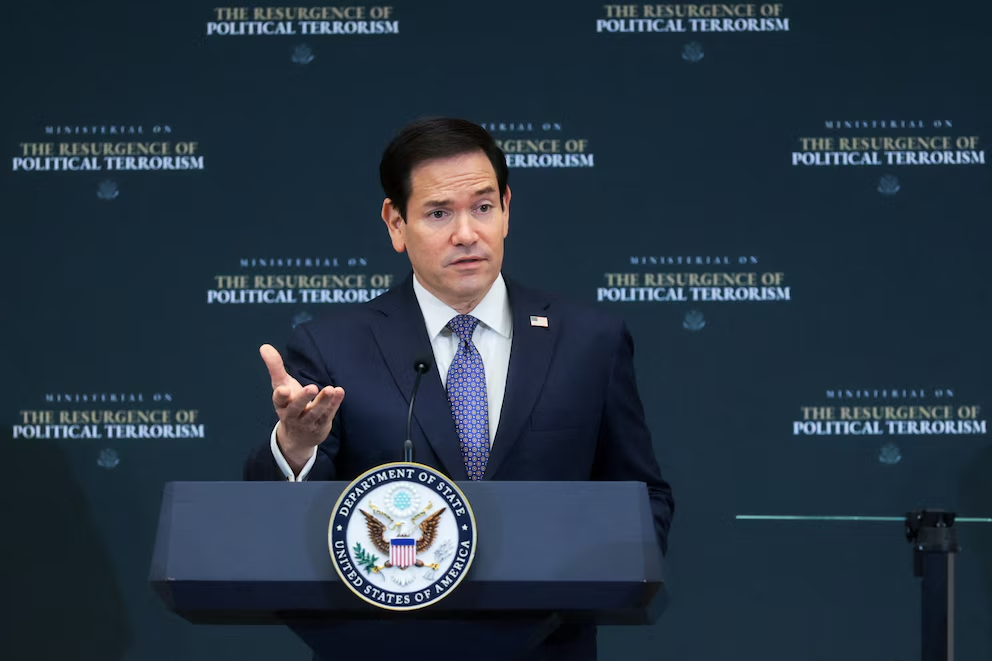
United States Secretary of State Marco Rubio assured that Washington will actively participate in the political transition process that will begin in Venezuela following the agreement reached between representatives of the National Assembly elected in 2015 and Chavismo.
The head of U.S. diplomacy described that understanding as a relevant step for the country’s future and stated that his administration will closely follow the development of the talks scheduled for August.
During a press conference, Rubio highlighted the consensus reached last week between both parties to launch a dialogue mechanism aimed at national reconciliation and the beginning of a political transition.
“They have agreed to establish a format and a forum not only for reconciliation talks, but also to begin the transition process, which is what the people of Venezuela need,” the U.S. official stated.
Rubio noted that the first official meetings of that body are scheduled for the first week of August and considered that the announcement had a favorable reception within Venezuela.
More Read
We recommend reading: Marco Rubio demands the release of Cuban political prisoners on the fifth anniversary of 11J
“We believe that this agreement was received in Venezuela as very good news and it is something in which we are going to be very involved”, he declared
Marco Rubio celebrated the agreement to begin the transition in Venezuela: “We are going to be very involved”
More Read
For years, the United States has recognized the National Assembly elected in 2015 as the last parliament to emerge from democratically recognized elections.
In addition to referring to the transition, Rubio confirmed that the United States will maintain the assistance intended to address the consequences of the earthquakes that struck Venezuela. He explained that the humanitarian aid already exceeds 180 million dollars and anticipated that this amount could increase as reconstruction efforts progress.
The head of U.S. diplomacy indicated that his government is also working to facilitate Venezuela’s access to international financing and credit mechanisms that allow for addressing the high costs derived from the emergency.

“It already exceeds 180 million dollars and we will do more”, he pointed out when referring to Washington’s financial support. He added that the reconstruction will require significant investments both to remove the rubble and to build new infrastructure.
Rubio’s announcement came just a few days after the start of a joint agenda between the Chavista regime and representatives of the 2015 National Assembly was confirmed.
Members of the United States Air Force arrive at Simón Bolívar International Airport, in Maiquetía, to participate in the distribution of humanitarian aid destined for the areas affected by the earthquakes.
More Read
According to the announced schedule, both parties will begin working formally starting on August 1st on a roadmap aimed at promoting agreements on different aspects of the Venezuelan political process.
The president of the commission representing the National Assembly elected in 2015, Dinorah Figuera, confirmed her willingness to participate in that mechanism and expressed her commitment to developing a joint technical and political agenda to advance the country’s democratic recovery.
In accordance with the approach presented by the former parliamentarians, the first topics of discussion will be related to the strengthening of institutions, the updating of the electoral system, and the restoration of guarantees for political participation.
The approach took place seven months after the departure from power of former dictator Nicolás Maduro and amidst the crisis caused by the earthquakes of June 24, which left more than 5,000 dead and caused serious damage in different regions of the country.
The impact of the earthquakes also affected the operation of public institutions. The National Assembly recently resumed its sessions in a temporary headquarters due to the structural damage suffered by the Federal Legislative Palace during the disaster.
Jorge Rodríguez and the president of the 2015 National Assembly, Dinorah Figuera, hold a meeting in Caracas to address the democratic transition process
Since the fall of Nicolás Maduro, the Chavista leadership has adopted some opening measures, among them the partial release of political prisoners—although, according to the NGO Foro Penal, more than 370 people remain detained for political reasons—, in addition to the re-establishment of diplomatic and consular relations with the United States and the announcement of reforms to reactivate the economy and attract foreign investment.
In parallel, conversations continue between Caracas and Washington to coordinate international assistance aimed at the country’s reconstruction. U.S. authorities believe that access to external financing will be a key element in addressing the recovery works required by the emergency caused by the earthquakes, while the new political dialogue process will officially begin during the first days of August.