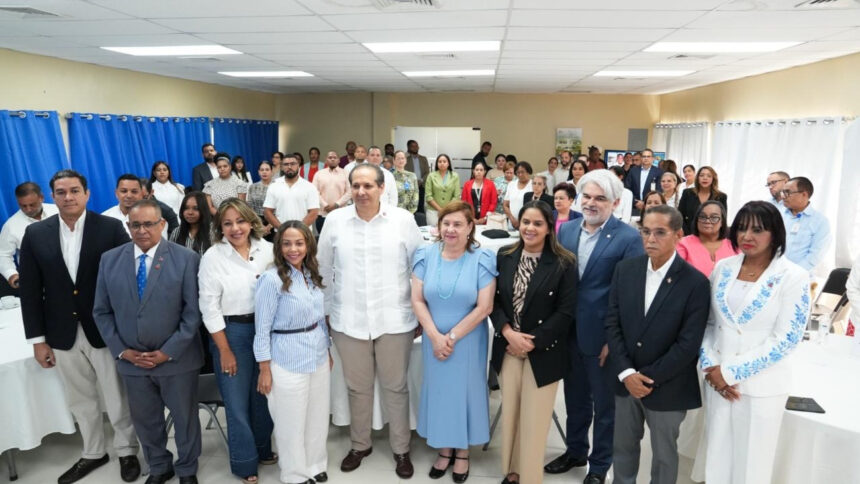
La Vega.– The Ministry of Health presented the results of the measurement of the maturity level of the Integrated Health Service Networks (RISS) in the Cibao Sur region, as part of the actions aimed at strengthening the Care Model based on Primary Health Care (PHC) and improving the integration of services received by the population.
The event was led by the Minister of Health, Víctor Atallah; the interim representative of the Pan American Health Organization and the World Health Organization (PAHO/WHO), Bernardino Vitoy; the provincial governor of La Vega, Luisa Jiménez; the Vice Minister of Strengthening and Development of the Health Sector, Yudelka Batista, and the Vice Minister of Collective Health, Eladio Pérez.
During his speech, the Minister of Health highlighted the institution’s commitment to strengthening the coordination between the different actors in the healthcare system, in order to consolidate a more integrated, efficient service network focused on the population’s needs.
“From the Ministry of Health, we are going to continue convening, we are going to continue articulating, we are going to continue generating the work, the efforts, the sweat, and the call so that the network becomes a system and so that the health system is guaranteed,” affirmed Atallah.
For his part, the interim representative of the PAHO/WHO highlighted that the measurement constitutes a fundamental tool to identify strengths and opportunities for improvement that allow progress towards a more integrated and resolute health system.
More Read

“This is an opportunity to look at ourselves as a system, to learn about our progress and identify our gaps and, above all, to strengthen our capacities to respond effectively to the needs of the population,” said Vitoy.

The evaluation, developed with the technical and financial support of the Pan American Health Organization (PAHO), determined that the Cibao Sur region reached a global development level of 49% in the integration of its health service networks. The results reflect progress in the organization of care with a territorial approach (56%), while the challenges identified are concentrated in integrated resource management, governance, and sustainable financing, aspects that will serve as a basis for planning improvement actions.
During the activity, the methodology used for assessing the maturity of the IHN (Integrated Health Services Networks) was also presented, a tool developed by PAHO that allows for the evaluation of the networks’ degree of development through an analysis of their main strategic components, with the aim of guiding decision-making and strengthening the quality, efficiency, and integration of health services.

We recommend reading:
As part of the evaluation process, in addition to the technical analysis carried out by the different levels of health system management, a survey of users of health facilities in the region was applied to learn about their perception of the integration of the service network, through 61 surveys conducted in hospitals, diagnostic centers, and primary care centers.
The workshop was attended by 78 representatives from institutions linked to the National Health System, including the Ministry of Public Health, the National Health Service (SNS), Promese/CAL, Sisalril, the National Social Security Council (CNSS), Idoppril, the Ministry of Finance, the Ministry of the Presidency, and the Pan American Health Organization.