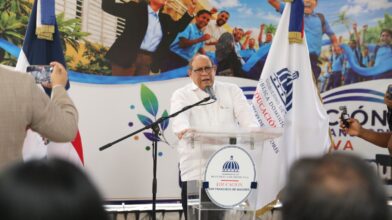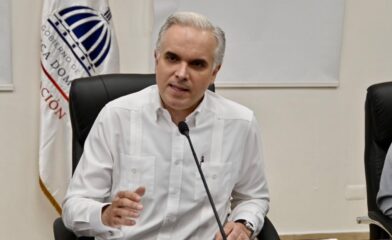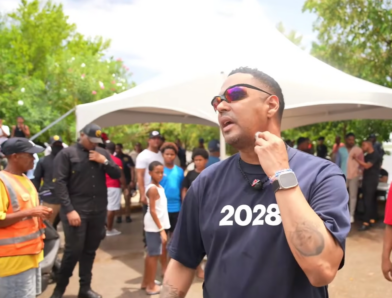
The Dominican Republic Tobacco Institute (INTABACO) initiated the 2025-2026 Tobacco Harvest with the planting of more than 160 thousand tareas of tobacco in Jacagua, Santiago province, in an event headed by the Minister of Industry and Commerce and Mipymes and president of the Tobacco Relaunch Table, Víctor Bisonó, and the director of the entity, Iván Hernández Guzmán.
Víctor Bisonó highlighted that the production and export of tobacco have grown more than 25 percent from 2019 to date, going from a production of 278,634 quintals to more than 330,000 quintals per year; which was reflected in an increase in exports from 934 million dollars in 2019 to more than 1,340 million annually currently.
Bisonó indicated that President Luis Abinader has a great commitment to the Tobacco Industry and highlighted that it has a great impact on the national economy for being the main generator of jobs in Free Zones with more than 38,000 jobs and more than 110,000 direct jobs in general.
While the director of the Agricultural Bank, Fernando Durán, indicated that the Dominican Government has granted more than 1,400 million pesos to tobacco producers in the current administration and that support for said sector will continue.
While the Vice Minister of Agriculture, Eulalio Ramírez, pointed out that tobacco is the third most exported product from the Dominican Republic after gold and medical supplies, and that for this reason the Dominican government supports the sector and is encouraging new cultivation areas in the Northwest line and in the South region of the country through the San Juan Plan.
More Read

Iván Hernández Guzmán, director of INTABACO, reported that for the 2025-2026 Tobacco Harvest, the planting of more than 160 thousand tareas of tobacco is planned, which will produce more than 400 thousand quintals of said product in 29 tobacco zones distributed in 15 provinces of the country with Criollo, Andullo, Havanensis, Olor Dominicana tobaccos; as well as the elaboration of wrappers.
Hernández Guzmán said that INTABACO works hard in advising producers on the process of soil preparation, planting, harvesting and cigar making; it promotes the tobacco industry nationally and internationally, advises on the marketing of the product and financing facilities through the Agricultural Bank and other entities. Likewise, it trains qualified labor through the Hipólito Mejía Tobacco School, manages jobs for its students, donates seedlings and seeds, collaborates with plowing land, donates fumigation pumps, sells wood at low costs for the construction of Curing Houses, among other actions.
“Since President Luis Abinader gave me the opportunity to take on this position, I began to coordinate actions with members of the Central Government, the Ministries of Agriculture, Industry and Commerce, Banco Agrícola, the Cigar Producers Associations (PROCIGAR), Cigars and Tobacco (ADOCITAB), with medium and small independent producers, with marketing companies, embassies and with representatives of other sectors to implement measures in favor of the industry,” said the official.

Iván Hernández Guzmán stated that “If today the tobacco industry of the Dominican Republic produces more than 131 million premium cigars a year, 8,000 million mechanized cigars, 21 varieties, if today we reach more than 140 countries, we are leaders in the export of premium tobaccos in the world and we have a strong and resilient industry, it has been thanks to those men and women who get up every day to contribute to its development with their minds, hands and hearts, for which I congratulate them.”
He considered it very important that President Luis Abinader has defined the development of tobacco production in San Juan and in provinces of the Northwest line and border area as a priority, as it represents development and new sources of employment.

As Juan Manuel Ureña, producer and owner of Transplanta, where the start of the 2025-2026 Tobacco Harvest took place, stated that the tobacco industry is undergoing a process of transformation, modernization, acquisition of new technologies and the technical training of its personnel to compete nationally and internationally. He thanked the Dominican Government for its support through advice and financing that contribute to the strengthening of the sector.
Radhames Rodríguez, president of the Dominican Association of Cigars and Tobacco (ADOCITAB) stated that the industry is working together to achieve its expansion and generate new sources of employment; while Litto Gómez, president of the Association of Cigar Producers of RD (PROCIGAR), affirmed that they are working to reach new markets in the United States and other countries.
Santiago Governor Rosa Santos; businesswoman and PRM leader Sonia Guzmán; the mayors of Villa González, Cesar Álvarez; of Navarrete, Noel Peralta and of La Canela, Carmen López; the ad vitam president of PROCIGAR, Henrik Kelner; Frank Rodríguez, chancellor of UTESA University; Ingrid González, deputy director of the newspaper La Información; Bernardo Hilario, director of the Norcentral Regional Health Service, among others, participated in the activity.
Tobacco growing areas and tobacco varieties of the DR
More Read
In the Dominican Republic, there are 160 processing companies for the product, 29 tobacco-growing zones distributed across 15 provinces that generate more than 330,000 quintals of tobacco each year.
The main tobacco growing areas are: Santiago, with 51%, Valverde, Monte Cristi, Espaillat, San Juan, Azua and Monseñor Nouel. While the main manufacturing provinces or where they are produced are Santiago, La Romana and Puerto Plata.
In addition, five types of tobacco are produced with 21 varieties, which are Dominican Olor, Havanensis, Introduced Havanensis, Local Criollo Tobaccos, Introduced or Cultivated Tobaccos for Wrappers.
From the Olor Dominicano tobaccos, the Quin Díaz, Chago Díaz, Papayo, Amarillo Parado, Olor San Víctor, Tumba Rancho and Carbonell varieties are made; from the Havanensis, the Piloto, San Vicente and Intabaco T-13 exist; from the Introduced Havanensis, the Criollo 98, Corojo, HVA and Negrito San Andrés are marketed, the official reported.
He added that the Local Criollo Tobaccos are generated in Pitrinche, Rabito and Punto; of the introduced and/or Cultivated Tobaccos For Wrappers, Connecticut, Broadleaf, San Andrés and Cameroon are produced.