A U.S. federal judge dismissed the copyright infringement lawsuit filed against Taylor Swift by freelance writer Kimberly Marasco.
The resolution puts an end to the legal proceedings initiated by the author, who maintained that the singer had used fragments of her poems in several songs released between 2019 and 2024.
According to court documents obtained by People magazine, Judge Aileen Cannon granted the motion to dismiss the lawsuit filed by Marasco on July 6.
The case was dismissed with prejudice, a legal term that prevents the plaintiff from refiling the same claim in court.
Kimberly Marasco will not be able to sue Taylor Swift for copyright again.

Marasco alleged that the singer had copied verses from her poems in more than a dozen songs included in the albums Lover, Folklore, Evermore, Midnights, and The Tortured Poets Department.
We recommend reading:Taylor Swift and Travis Kelce’s wedding brings together figures from entertainment, music, and the NFL in New York
In her resolution, the judge concluded that the similarities pointed out by the plaintiff corresponded to general ideas and expressions that are not protected by copyright law.
More Read

According to the ruling, both Marasco’s poems and Swift’s compositions share “basic ideas,” including the concept of gaslighting, frequently used metaphors, and common observations.
“These are themes, concepts, and isolated words par excellence; exactly the type of material that copyright law does not protect”, the judge wrote in the ruling
The judge maintained that the phrases Taylor Swift uses in her songs are of popular use.
Later, Cannon added that “the allegedly infringed material—basic ideas, themes, metaphors, isolated words, and short phrases—does not constitute protected expression and, therefore, cannot be the subject of infringement.”
The judge also determined that Kimberly Marasco had already had sufficient opportunities to present and correct her lawsuit during the judicial process. Therefore, she refused to authorize a new modification of the file.

“The plaintiff has had ample opportunity to present her claims; she was expressly warned that the second amended complaint would be her last opportunity,” noted Cannon.

In another section of the ruling, the magistrate concluded that a new modification would not change the outcome of the case.
“The court concludes that the plaintiff’s poems do not contain protectable expression and that, furthermore, the plaintiff failed to plausibly present that copying existed,” he wrote.
The judge stated that Taylor Swift’s plaintiff’s lyrics should not be protected.
The litigation originated in 2024, when Kimberly Marasco filed a lawsuit against Taylor Swift Productions, the singer’s company, claiming that some of her works had been used in songs such as “The Man”, “Illicit Affairs”, “My Tears Ricochet” and other tracks.
That same year, the author filed a second lawsuit with similar accusations, according to information published by Billboard.
Taylor Swift‘s lawyers rejected the accusations from the beginning. In September 2025, the first case was dismissed by a court, also according to Billboard.
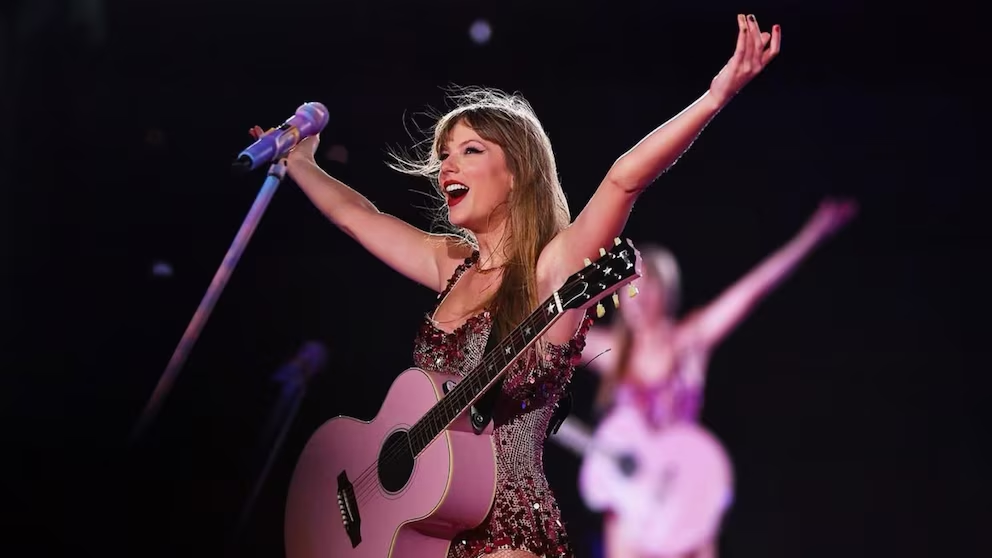
In that ruling, Judge Cannon determined that Marasco did not have exclusive rights to various commonly used words and expressions that he claimed had been copied by the singer. In 2025, a lawsuit against Taylor Swift had already been dismissed. REUTERS/Mario Anzuoni
Subsequently, in December 2025, Swift’s defense requested the definitive closure of the second judicial process. According to Billboard, attorney Douglas Baldridge argued that the plaintiff “had no conceivable case” against the artist and recalled that a previous lawsuit had already been dismissed.
At that time, the legal representative maintained that it was “the second frivolous and harassing lawsuit filed by the plaintiff against the artist” and stated that the accusations were, “as in the previous litigation, absurd and lacked legal basis.”
The resolution issued on July 6 coincided with those arguments. The judge indicated that words and expressions such as “tears”, “running”, “fire”, “rain”, “sky”, “love”, “invisible”, “caged me”, “flesh and blood” and “it’s time to go” correspond to common terms and phrases that cannot be subject to exclusive protection under copyright law. The judge determined that Taylor Swift would not have infringed copyright with her lyrics.
The second lawsuit also incorporated new accusations related to songs from the album The Tortured Poets Department, including “I Can Do It with a Broken Heart” and “The Manuscript”.
However, the judge concluded that those claims also did not meet the legal requirements to sustain a copyright infringement case, so the proceedings were definitively closed.