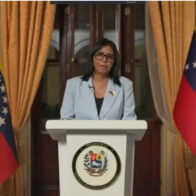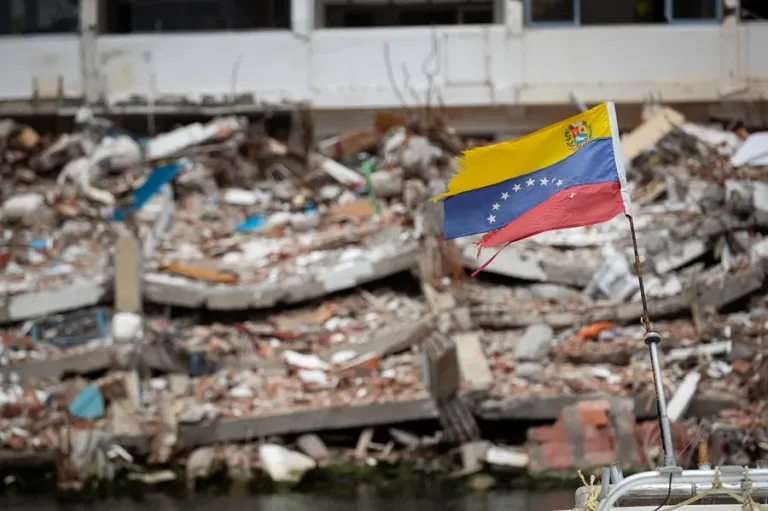
Caracas.- The number of deaths in Venezuela due to the double earthquake on June 24th reached 6,301, after adding another 176 deaths compared to the previous toll, according to figures published this Monday by the president of Parliament, Jorge Rodríguez.
The brother of the acting president, Delcy Rodríguez, also indicated that 73,356 people have been treated in hospitals.
Likewise, he said that the Government has delivered 287 homes following the double earthquake of magnitude 7.2 and 7.5 that affected the northern area of the South American country, especially the state of La Guaira.
In addition, he pointed out that the authorities have evaluated 53,314 homes, of which 31,336 were classified as habitable; 12,411 with restrictions and 9,567 at “high risk”.
Rodríguez added that 483,525.41 tons of debris have been collected.
More Read

Power outages due to earthquakes in Venezuela
On the other hand, the first vice president of the ruling United Socialist Party of Venezuela (PSUV), Diosdado Cabello, indicated this Monday that the power outages affecting a large part of the national territory are due to the earthquakes of last June 24 and the El Niño climate phenomenon.
During the party’s weekly press conference, Cabello questioned that there are people who deny that earthquakes cause effects on the National Electric System (SEN).
“Of course,” he said, noting that “only in the center of the country” was infrastructure damaged, causing a loss of “600 megawatts.”
“How do you recover 600 megawatts? Why, did you think about it? No, no, you have to do the work,” he added.
More Read

The also Minister of Interior assured that the state-owned Electric Corporation (Corpoelec) is working to improve the electrical system.
In that sense, he highlighted the agreements reached with other companies and “the effort” that the Government is making to address the issue.

Energy problems in Venezuela
For years, Venezuela has suffered from power supply failures, which Chavismo has blamed on foreign sanctions, while the opposition and experts assert that it is the result of corruption and a lack of maintenance.
Blackouts can last up to six hours in different regions of the country.
On August 2nd, the acting president, Delcy Rodríguez, asked the country to save electricity and water in the face of the ‘Super El Niño’ climate phenomenon, as a high-intensity episode of El Niño is colloquially known, and announced a plan to add 4,800 megawatts (MW) to the electrical system for the remainder of the year.
We recommend reading: Number of migrant bodies recovered off the coast of Ceuta, Spain, rises to 67
The president then said that she requested “specific plans” to address the increase in temperatures and the reduction of water sources, with a view to incorporating 4,800 MW into thermoelectric generation.
More Read

On Saturday, Rodríguez appointed Juan Crisóstomo Fernández as the new president of Corpoelec to strengthen the team in charge of reviving the electrical system.
Updating seismic-resistant standards
This Monday, the Venezuelan College of Engineers called for updating the seismic-resistant standards for buildings and the country’s urban planning.
Through a press release, the president of the association, Enzo Betancourt, proposed the creation of a National Earthquake-Resistant Commission in charge of evaluating and issuing “public reports on the causes of collapses; formulating recommendations to update and strengthen national earthquake-resistant regulations”.
Betancourt also highlighted that said commission will serve as an “input for public policies regarding disaster risk reduction, territorial planning, resilient reconstruction, and reviewing urban planning laws and regulations for design, construction, inspection, and supervision of buildings and infrastructure”.
The latest update to the seismic-resistant standards was made in 2019, according to the association itself.
The World Bank estimates the direct physical damage from the 7.2 and 7.5 magnitude earthquakes on June 24 at $19.6 billion and recently warned that a slow reconstruction could hinder the oil-producing country’s economic recovery over the next decade.