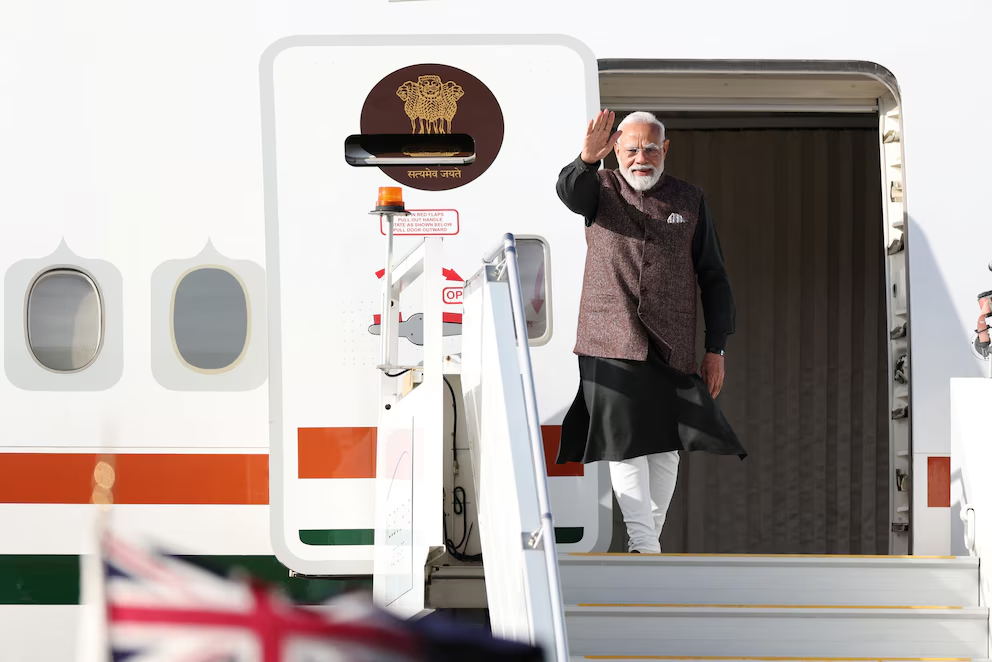
The Prime Minister of India, Narendra Modi, arrived this Friday in New Zealand to promote the free trade agreement signed between both countries, in a visit that coincides with growing controversy over statements by political leaders and public figures against immigration and the Indian community. The official agenda includes meetings on trade, tourism, and sports, as the New Zealand government seeks to consolidate an agreement it considers key to economic growth.
New Zealand Prime Minister Christopher Luxon defended the free trade agreement signed in April with the world’s most populous country and maintained that the deal will boost exports, investment, and employment. The pact still needs to receive approval from the New Zealand Parliament, although it is expected to secure the necessary support to enter into force.
However, sectors of the ruling coalition questioned some sections related to migration and visas. Legislators from the New Zealand First party expressed their rejection of those provisions.
Minister Shane Jones summarized that stance during a radio interview. “I don’t care how much criticism we get, I am simply never going to accept a tsunami of butter chicken coming to New Zealand,” he stated. The remarks sparked a strong reaction within the Indian community. A community leader described Jones’s words as “absolute racism,” according to the cable.
We recommend reading:
More Read

The controversy grew following comments by evangelical preacher Brian Tamaki, who criticized Modi’s arrival and launched a message against various religious communities. “Let’s purge New Zealand of Hindus, Sikhs and Muslims,” Tamaki expressed on Instagram. The preacher added: “Since they are burning churches, why don’t we burn mosques and their temples? An eye for an eye.”
The statements received immediate condemnation from New Zealand’s Race Relations Commissioner, who described them as “absolutely appalling.”
New Zealand Prime Minister Christopher Luxon defended the free trade agreement signed in April with the world’s most populous country and maintained that the deal will boost exports, investment, and employment (EFE)
Modi’s visit also coincides with other episodes of tension linked to racial issues. Earlier this year, Māori activist Che Wilson faced accusations for allegedly insulting an Indian-born New Zealand lawmaker during a cultural performance of a haka that, according to the complaints, included racially charged references.
Massey University anthropologist Sita Venkateswar stated that the Indian leader’s visit occurs in a context where New Zealanders of Indian descent are facing an increase in discriminatory episodes.

“A ‘butter chicken tsunami’, insults accompanied by a haka, graffiti on a school wall: South Asians are now the group that most frequently appears as the target of racially motivated incidents in our data,” he stated.
The specialist added: “That is real and it is wrong”.
Modi will remain in New Zealand for a little over a day. His stopover is part of a tour carried out between July 6 and 11 that also included visits to Indonesia and Australia.
During their stay, they will participate in an official ceremony at Government House and attend a business and sports meeting in Auckland. The trip marks the first visit by an Indian head of government to New Zealand in four decades.
More Read

One of the central events will be a meeting with the Indian diaspora at the Spark Arena stadium in Auckland, where the attendance of up to 10,000 people is expected.
Modi will remain in New Zealand for a little over a day. His stopover is part of a tour carried out between July 6 and 11 that also included visits to Indonesia and Australia.
Despite the controversy sparked by some public statements, the Luxon Government sought to convey a message of welcome to the Indian leader. New Zealand is home to a community of Indian origin comprising about 300,000 people, one of the fastest-growing migrant groups in the country.
In that context, Luxon highlighted the strategic value of the bilateral bond and the potential of the new trade agreement.
“This visit serves to celebrate a successful partnership between New Zealand and India, a relationship that benefits our people and fosters greater prosperity and security for both countries,” he stated.