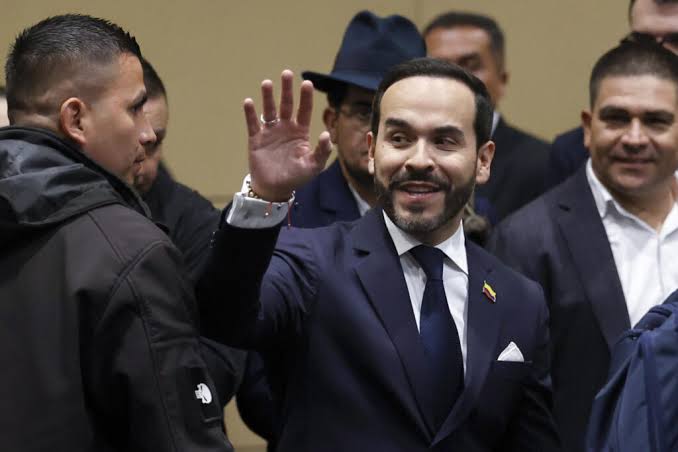
Bogotá,.- Lawyer Abelardo de la Espriella will take office on August 7 as President of Colombia for the 2026-2030 term in an unprecedented ceremony that will take place in Cali, the main city in the southwest of the country, with the presence of part of the Congress and foreign guests, including King Felipe VI of Spain.
The relocation of the inauguration ceremony from Bogotá to Cali has been marked by controversy, not only due to the change of venue but also because of the message De la Espriella intended to send with this decision, that, as he often says, he arrived “to change politics forever.”
You might be interested in: The President of Colombia receives the credentials of the Palestinian ambassador ten days before the end of his term
Cali, the capital of Valle del Cauca, was the option chosen by the president-elect after his idea of holding it at a military garrison in Popayán, capital of neighboring Cauca, to pay tribute to “the true heroes of the nation” in an area marked by armed conflict, was discarded due to the risk of an eruption of the nearby Puracé volcano, currently on orange alert.
“For the first time in our republican history, a President of the Republic will be sworn into office outside of Bogotá; this historic event will take place in Santiago de Cali and represents the first step of a decentralization policy that will bring the State to the regions,” said De la Espriella on Sunday in a message on his social media.”
The possibility of taking office in a battalion in Cauca actually implied major drawbacks, not only from a security, logistical, and protocol standpoint, but also due to the negative political message that would be sent to the country regarding the subordination of civil power to the military.
“What De la Espriella is seeking is to send a message about restoring the freedom of military powers to combat the main security issues in Colombia, which are generally linked to drug trafficking and insurgent groups, while Gustavo Petro opted for dialogue and concessions,” analyst Fabián Cárdenas, a professor of international law at the Pontificia Universidad Javeriana in Bogotá, told EFE.
Decentralization of power
The Colombian capital, seat of the three branches of government, was not in the president-elect’s plans for either his inauguration or for governing, as he insists on decentralizing the Administration and therefore wants to turn the Caribbean city of Barranquilla into an alternate capital of Colombia, and Cali and Medellín into satellite seats of the Presidency.


In this way, the inaugural act of his Presidency will shift from the solemnity of the Elliptical Hall of the Capitol or the grandeur of the adjacent Bolívar Square, in the center of Bogotá, to the coldness of a university auditorium that looks like a sports coliseum in Cali.
The chosen venue is the USC Arena, at the Santiago de Cali University, a modern multipurpose complex with a capacity for more than 2,300 people that features over 800 parking spaces, a helipad, state-of-the-art sound and lighting systems, and high-definition LED screens.
In that place, De la Espriella will swear to respect and uphold the Constitution and the Law before a majority of senators and representatives to the House, other national authorities, and international guests, including King Felipe VI and the presidents of Argentina, Javier Milei, and Paraguay, Santiago Peña, the only ones confirmed so far by his government team, although other Latin American leaders are expected.
Tributes and protests
Following the inauguration ceremony, De la Espriella is expected to head to the Army’s Pichincha Military Canton, 2.6 kilometers away, for the tribute he wishes to pay to the Military and Police Forces, an act that has not yet been officially confirmed.
De la Espriella is characterized by a taste for ostentation and lavishness, but paradoxically, he wants his inauguration to be austere, without celebrations like four years ago when, after his swearing-in, Gustavo Petro was welcomed at the Casa de Nariño, the seat of the Executive branch, with porros and fandangos by the 19 de Marzo Band from the Caribbean department of Córdoba.
“My inauguration, dear compatriots, so that you may be at ease, will be an austere ceremony and will be the first demonstration that decentralization ceases to be a speech to become a reality,” he stated this Sunday.
More Read
For the first time in modern times, the president will not be sworn into office before the full Legislative Branch because the Pacto Histórico caucus, the party of Petro and Iván Cepeda, a candidate defeated by De la Espriella at the polls, does not recognize his election and will not travel to Cali.
The left will demonstrate that day in Barranquilla, led by Cepeda; in Bogotá and in Cali as part of the “civil disobedience” to the new Government.