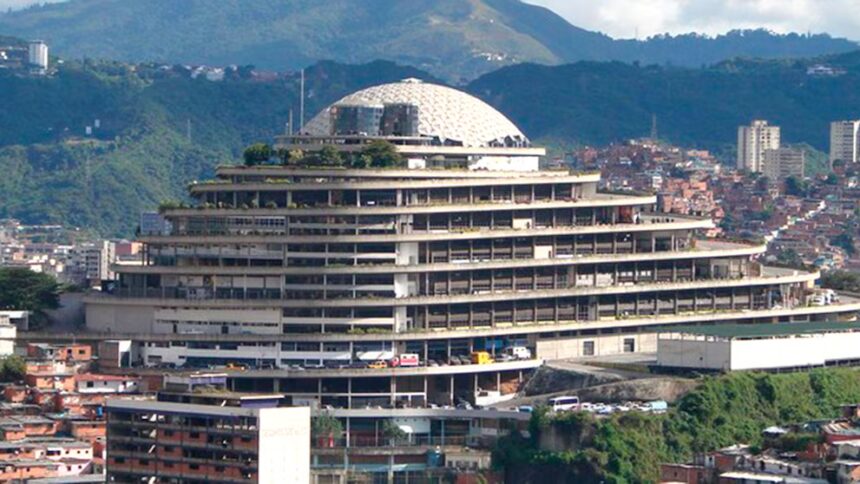
The Inter-American Court of Human Rights ordered this Wednesday the closure of El Helicoide, the largest torture center in Venezuela and one of the symbols of Chavista repression repeatedly denounced by international organizations.
The decision was adopted in a ruling that condemned the Venezuelan State for the arbitrary detention and the abuses suffered by the student Jorge Rojas after a demonstration held in Caracas in 2003.
The court established that the Chavista leadership must close the detention center within a maximum period of 18 months from the notification of the ruling. Furthermore, it ordered that the individuals currently held in those facilities be transferred to other establishments that guarantee conditions compatible with international standards regarding physical integrity, personal liberty, and due process.
“The Court deems it pertinent to order the State to arrange, within a period of 18 months from the notification of this judgment, the closure of the ‘El Helicoide’ detention center”, the resolution states. The ruling also orders that any transfer of detainees be carried out while respecting the guarantees provided for in the American Convention on Human Rights.
We recommend reading:
More Read

The decision represents one of the most severe pronouncements issued by the inter-American system regarding Venezuela. In their ruling, the judges noted that multiple national and international bodies have documented for years reports of torture, arbitrary detentions, and cruel treatment within that detention center.
The court convicted the Venezuelan State for the torture suffered by a student detained during a protest in Caracas and set a deadline of 18 months to execute the measure
The Court especially highlighted the conclusions of various human rights monitoring mechanisms that identified a persistent pattern of abuses against persons deprived of liberty. Among them is the Independent International Fact-Finding Mission on Venezuela, created by the United Nations Human Rights Council.


According to the ruling, there are sufficient grounds to conclude that numerous detainees at El Helicoide were victims of torture and other degrading treatment while remaining in state custody. The ruling attributes these violations to Venezuelan intelligence agencies operating at the site.
The case that led to the international conviction dates back to September 19, 2003, when Jorge Rojas was arrested during a protest held at Plaza Francia in Altamira, one of the main gathering points for opposition demonstrations during the government of Hugo Chávez.
The magistrates concluded that the authorities unduly restricted their participation in a peaceful protest and violated rights related to freedom of expression, freedom of thought, and political participation.
The ruling dedicates a central part to the abuses suffered by Rojas during his time in state custody. According to the Court’s findings, the student was subjected to acts of torture while he was detained at El Helicoide.
“He was subjected to acts of torture, he was beaten on different parts of his body, he was subjected to threats of sexual violence, numerous indignities, he was held at gunpoint, and subjected to mock executions”, the ruling indicates. Relatives of detainees protest in front of the Public Prosecutor’s Office in Caracas to denounce alleged torture and mistreatment in Venezuelan prisons and detention centers
The Court further held that those assaults occurred in a context of impunity regarding similar complaints recorded at that same detention center. The judges pointed out that those responsible for the events were never adequately investigated and that the Chavista regime failed to fulfill its obligation to clarify what happened.
More Read

Following his arrest, Rojas was sentenced in 2004 to four years and six months in prison for various crimes. His defense filed appeals to challenge the decision, but the Venezuelan judicial authorities upheld the conviction. It was not until 2009 that his criminal liability was declared extinguished and his full release was ordered.
El Helicoide was originally conceived in the 1950s as a commercial and architectural complex of great scale, but it never fulfilled that function. Over the years, it was occupied by state agencies and ended up becoming the headquarters for intelligence services.