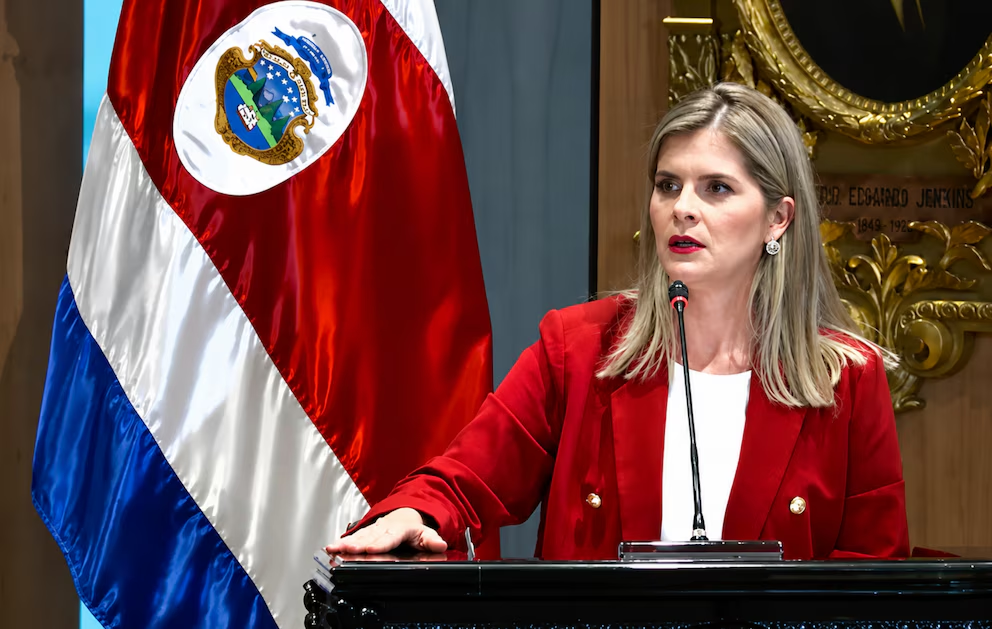
The President of Costa Rica, Laura Fernández, defended the pension regime for former Presidents of the Republic, stating that this benefit represents recognition for the particularities of the position and allows those who held the Presidency to maintain a sustainable standard of living once their term concludes.
His statements mark a shift from the discourse that the Chavista movement maintained during the 2022 electoral campaign and which the president herself took up again on May 8, when she promised to promote “whatever battles are necessary” to eliminate the so-called luxury pensions.
Fernández was asked whether she believes that pensions for former presidents should be abolished. In response, she maintained that the Presidency of the Republic possesses characteristics distinct from any other public office, which, in her view, justifies the existence of that benefit.
“The office of President of the Republic has a series of prerogatives distinct from many other public offices, and that is why a pension for former presidents is recognized worldwide. More than a pension, it is a recognition so that, after having held this office, they have an income that allows them to continue with a sustainable standard of living, given that it can be difficult to re-enter the workforce. There are security issues and other important matters,” he stated.
Laura Fernández’s position contrasts with the Chavista movement’s promise to eliminate so-called luxury pensions. Credit: Screenshot from the Presidency of the Republic broadcast
More Read

We recommend reading: The President of Costa Rica accuses the magistrates who extend appointments in the Constitutional Chamber of being “coup plotters”
Although he added that, in his case, he hopes to continue working “as long as God gives him life and health,” he made it clear that he does not support the automatic elimination of this regime.
The president’s statements came after the Social Affairs Commission of the Legislative Assembly rejected the report on the bill that seeks to eliminate pensions for former presidents of the Republic.
More Read
Voting against the report were the pro-government deputies Ana Katharina Müller, Esmeralda Britton, Robert Junior Barrantes and Royner Mora, as well as the National Liberation Party legislator Iztarú Alfaro.

As a consequence, the file will continue its legislative process with a negative majority report and will be sent to the Legislative Plenary.
The initiative aims to eliminate this special regime and, for those already receiving the benefit, establishes that they may only retain it if they demonstrate that they receive income of less than three base salaries from other sources and that they do not receive a basic contributory pension.
The debate has reignited questions about a shift in stance within the ruling party. Since the 2022 presidential campaign, then-candidate Rodrigo Chaves made the elimination of luxury pensions one of his main political banners and assured that he would push for the disappearance of benefits he considered unjustified, including the pension for former presidents.
He even went so far as to state that he would seek to eliminate his own right to receive that payment once his term concluded.
Over time, the discourse began to change. In February of this year, the head of the ruling party faction, Pilar Cisneros, described the project as a “settling of scores” against Chaves, while this week the deputies of the Sovereign People’s Party voted to keep the regime in effect.
More Read

Now, with the public defense made by Laura Fernández, the Government consolidates a position different from the one it promoted during the electoral campaign. The discussion also gains relevance because both Fernández and Chaves could access this benefit in the future, which is around ₡4 million per month (USD 8,800), provided they meet the requirements established by current legislation.
Carlos Alvarado is the only former president who does not receive a pension.
Currently, seven of the eight former presidents entitled to the scheme receive that pension, while former president Carlos Alvarado reported at the time that he voluntarily renounced the benefit.
The Executive’s new position promises to keep open a debate that pits the principle of austerity defended by the ruling party against the arguments of institutional recognition and security now put forward by the Presidency.