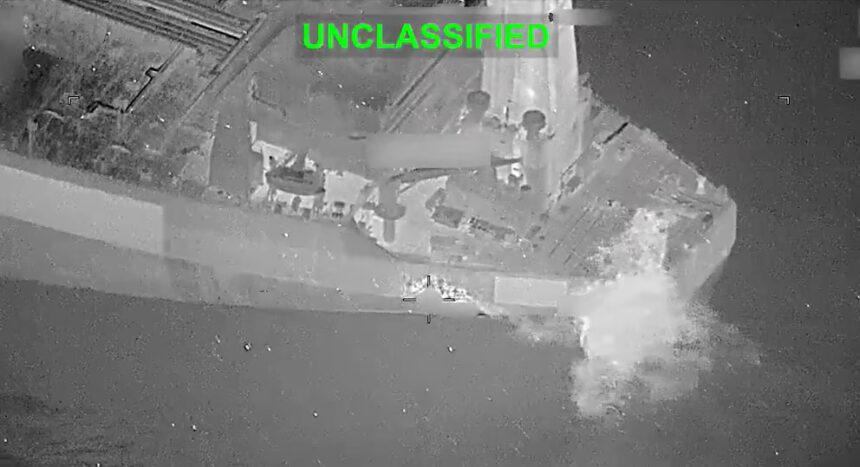
The United States reported this Tuesday that it disabled an oil tanker that, it claimed, was attempting to violate the maritime blockade imposed on Iranian ports. The operation was announced by the U.S. Central Command (CENTCOM), which stated it had used a Hellfire missile to prevent the vessel from reaching the territory of the Islamic Republic.
According to the statement, the incident occurred when the oil tanker M/T Lexie, flying the flag of Botswana, was sailing through international waters heading towards Kharg Island, Iran’s main oil terminal in the Persian Gulf.
“The vessel’s crew ignored repeated warnings and failed to comply with U.S. forces’ instructions on multiple occasions over a 24-hour period”, CENTCOM maintained.
Following those warnings, the United States decided to intervene militarily. According to the statement, “a U.S. aircraft finally disabled the vessel by firing a Hellfire missile into the ship’s engine room,” an action that, according to Washington, prevented the tanker from reaching an Iranian port.
We recommend reading: A plane bound for Spain returns to the United States due to a Bluetooth speaker named ‘bomb’
More Read

The Central Command specified that the vessel was not carrying cargo at the time of the incident.
The action took place within the framework of the maritime blockade that the United States has maintained over Iran since April 13. Washington maintains that all vessels entering or leaving Iranian ports are subject to inspections and interdiction measures as part of post-conflict operations with Tehran.
The United States fired on an oil tanker in the Persian Gulf that was attempting to violate the maritime blockade imposed on Iran (CENTCOM)
More Read

“CENTCOM began implementing the blockade of all maritime traffic entering and exiting Iranian ports on April 13”, the military command recalled in its message.
According to figures released by the United States, since that measure came into effect, U.S. forces have disabled six commercial vessels and forced 122 others to change course.

“US forces have disabled six commercial vessels and redirected 122 as the ceasefire with Iran continues,” CENTCOM indicated.
New incidents in the midst of negotiations
The action against the M/T Lexie occurred just one day after the United States confirmed a series of attacks against Iranian facilities, in a new demonstration that the ceasefire in effect between both parties continues to be accompanied by episodes of military confrontation.
Central Command reported on Monday that U.S. forces carried out “self-defense” operations over the weekend against targets linked to the Iranian drone program. According to Washington, the strikes hit radars, command and control centers, and other facilities located in Goruk and on Qeshm Island.
The offensive was presented as a response to what the United States described as “aggressive actions” by Iran, including the downing of a U.S. MQ-1 drone operating in international waters.
More Read

According to figures released by the United States, since the blockade on Iran came into effect, U.S. forces have disabled six commercial vessels and forced 122 others to change course.
“US fighter aircraft responded quickly, eliminating Iranian air defenses, a ground control station, and two one-way attack drones that posed a clear threat to vessels transiting regional waters”, CENTCOM noted in a statement.
Washington also assured that none of its personnel were injured during the operation and reiterated that it will continue to respond to any threat against its forces or against commercial navigation in the region.
Military incidents are occurring while the United States and Iran maintain diplomatic contacts aimed at reaching a broader agreement to consolidate the ceasefire and reduce tensions in the Middle East. The talks are being held with the mediation of Pakistan and cover topics ranging from maritime security to the Iranian nuclear program.
You can also read: United States Ambassador rejects political manipulation of justice; supports the rule of law
President Donald Trump confirmed that negotiations remain active, although he acknowledged that significant differences persist. The president also noted that he is personally reviewing some points of the draft agreement, especially those related to Iran’s enriched uranium stockpiles and a potential reopening of the Strait of Hormuz.