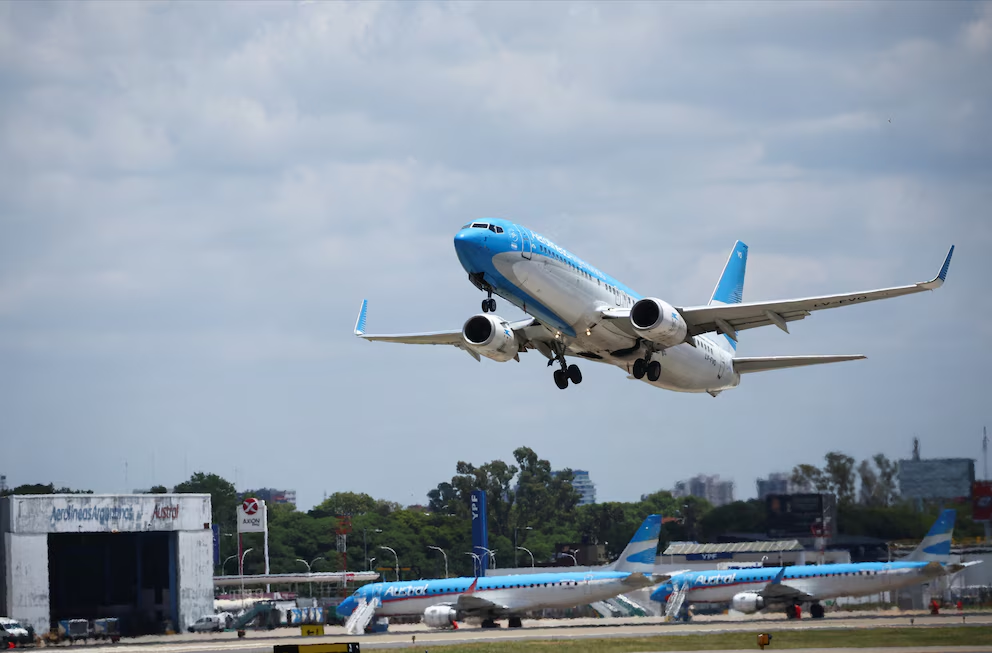
A Washington court ruled in favor of a foreign investment fund and confirmed that Argentina must pay more than USD 390.9 million for having nationalized Aerolíneas Argentinas nearly two decades ago. The District of Columbia Court of Appeals rejected the appeal with which the Argentine State attempted to annul the first-instance ruling, and upheld the judgment in favor of Titan Consortium, the fund that is now claiming that money.
The conviction is among the most costly that Argentina faces outside its borders. In the last 16 months, the country has not paid any sum of this award, a situation that led Titan to accelerate its legal offensive. Sources from the company indicated to Infobae that the ruling is not an action against the company but against the Argentine State.
As revealed by analyst Sebastián Maril, of Latam Advisors, the District of Columbia court rejected the appeal with which the Argentine State sought to reverse the first-instance ruling. With that decision, it was ratified that the fund can proceed in the U.S. justice system to attempt to collect the compensation.
The origin of the claim
The dispute began in 2008, when the government of Cristina Kirchner nationalized Aerolíneas Argentinas and Austral, which were then controlled by the Spanish group Marsans. The company maintained that the expropriation had been unfair and took the case to the International Centre for Settlement of Investment Disputes, the World Bank’s arbitral tribunal for disputes between States and investors.
More Read

In 2017, ICSID ruled in favor of Marsans and set compensation of USD 320 million plus interest. The Spanish company did not manage to collect that sum and later transferred the litigation rights to Burford Capital, a British fund that also litigated against Argentina for the expropriation of YPF.
The legal dispute over the expropriation of Aerolíneas Argentinas has been going on for more than 15 years and still has no closing date
Afterwards, Burford sold those rights to Titan Consortium, which since 2021 has been pushing in Washington for the recognition and enforcement of the arbitral award. The central point of the case is that ICSID decisions are not executed directly against a State’s assets, but must be recognized by local courts to attempt their enforcement.
More Read

Maril explained that mechanism: the awards serve as a basis to go to ordinary justice and request that the sentence be enforced. That is what Titan did in the United States and what has now received new judicial backing.

The ruling increases pressure on Argentine assets abroad
The confirmation of the conviction leaves Argentina in a more vulnerable position against attempts at seizure. In May, Titan had already sought to move against the collateral of the Brady Bonds deposited at the Federal Reserve Bank of New York, in a maneuver that also sought to get ahead of the agreement reached by the country with the Attestor and Bainbridge funds.
The economic origin of the conflict refers to the state in which Aerolíneas and Austral were left before the nationalization. During the Marsans management, valuable assets were sold, including offices in Rome, Paris, New York, Miami, Madrid, Bogotá, Lima, and Caracas, as well as flight simulators, and international routes to Europe were canceled.
At the time of the expropriation, both companies had accumulated liabilities of nearly USD 890 million. Marsans had acquired them in 2001 for a symbolic dollar, while the Spain treasury had to contribute around USD 750 million to sustain their operations.
Titan Consortium has been litigating in the US courts since 2021 to collect the compensation that ICSID granted to Marsans following the nationalization of the flag carrier airline
Two valuations carried out at the time showed opposite results. Crédit Suisse estimated that the value of the airlines was between USD 250 and USD 450 million, but the National Appraisal Tribunal calculated a negative value exceeding USD 760 million, a figure that the Argentine Congress used as a reference to justify the nationalization.
More Read

Aerolíneas reaches a surplus
The resolution comes at a time of financial improvement for Aerolíneas Argentinas. The new government had assured from the beginning that its intention was to clean up the company in order to privatize it, and the company closed 2025 with an operating profit of USD 112.7 million, almost double the USD 56.6 million recorded in the previous period.
Already in 2024, it had achieved the first operating surplus since the re-nationalization, the first time the company operated without Treasury contributions, something that was repeated last year. The board has already informed the Ministry of Economy that it will not request funds in 2026 either.
The improvement in results came, mainly, from the reduction in personnel—reaching its lowest staffing level in 14 years—, the elimination of unprofitable routes, the closing of offices, and operational improvements that allowed its operation to become profitable. However, to privatize it, the measure must have the approval of Congress, something that did not flow when the Government moved forward with the first list of privatizable companies within the Bases Law at the beginning of its term.