Just a few days after the massive entry that put the Ceuta border in check, social media has once again become the main focus of concern. Since the end of last week, dozens of posts have begun to circulate calling for organizing a new attempt at irregular access to the autonomous city during the night of August 15, a call that is already being closely monitored by the State Security Forces and Corps and which the Ceuta Government itself acknowledges it is observing with concern.
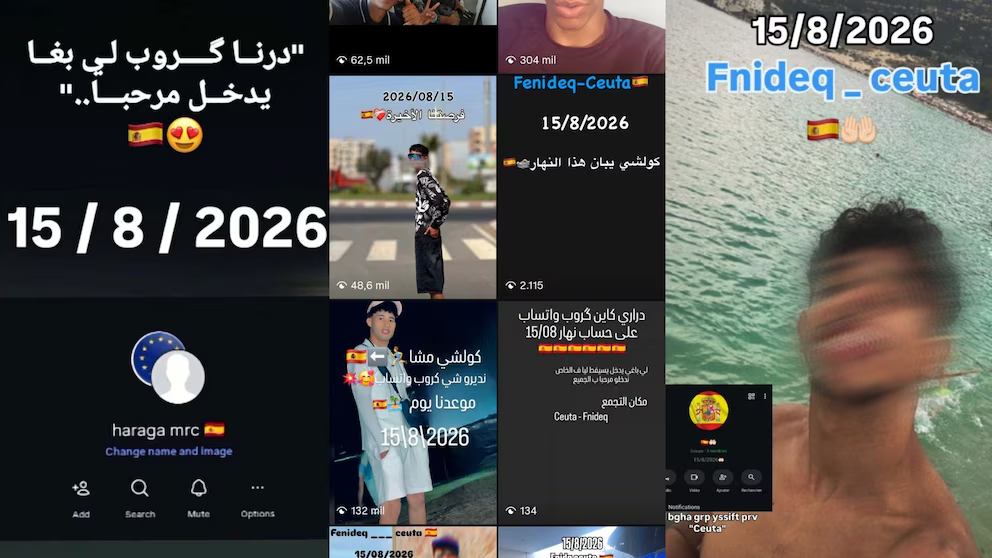
The message is repeated with practically the same format across different profiles, many of them with significant reach among Moroccan users. “We have created a group. Whoever wants to join, you are welcome,” can be read in one of the posts, accompanied only by a date: 08/15/2026. Others appeal directly to mobilization with phrases such as “Our last chance” or “Everything will be seen that day,” while encouraging users to join private groups from which the call is being coordinated.
Although for now everything is limited to posts on social media and messaging applications, the scenario inevitably recalls what happened before the migration crisis at the end of July. Back then, similar messages also began to spread, calling for people to gather in the Moroccan town of Castillejos (Fnideq) to attempt a mass entry into Ceuta. That call ended up leading to one of the largest irregular entries recorded in the autonomous city in recent years.
The new posts recurrently use the term “harraga Morocco”, the expression known in North Africa for those who attempt to emigrate irregularly to Europe. According to various local media outlets, some of the groups created to organize the call already have up to a thousand participants.
We recommend reading:Spanish government claims that 70,000 of the 72,000 people who arrived in Ceuta have returned
More Read

From Facebook to WhatsApp: this is how the call is organized
The call has found its main channel of dissemination in Facebook, WhatsApp, Telegram, and Instagram groups, where since the massive entry on July 30th, numerous users have been exchanging messages about a new crossing attempt scheduled for August 15th. In these spaces, posts related to the mobilization are shared, new participants are added to messaging channels, and the date of the alleged attempt is debated, with some users even suggesting the possibility of moving it up a few days.
Each platform plays a different role. Facebook functions as the great showcase from which calls are disseminated and new participants are recruited. There, questions about the “August 15th plan” abound, while other users respond by sharing invitation links or providing their phone numbers to be added to private groups.
Once the conversation moves to WhatsApp, the nature of the content changes completely. The messages stop focusing on the call to action and begin to address organizational issues. Participants comment on the state of the border, exchange information about police presence, ask about the situation of those who managed to cross during the last crisis, and share general recommendations for those intending to try in the coming weeks.
More Read

Several migrants are heading towards the border with Morocco to leave Ceuta.

In some of those groups, there are even messages suggesting a change to the initially planned date. Several users argue that August 15th could attract too many people and propose moving the attempt forward by a few days to avoid a larger police deployment.
Instagram serves a different function. Numerous personal profiles have begun posting photographs on which only the date August 15, 2026 is superimposed, accompanied by tags such as Fnideq, Fenideq, or FENIDG CEUTA, in reference to the Moroccan town from which these types of calls usually originate. Many of those profiles had never published content related to migration until the days following the mass entry at the end of July.
Telegram, for its part, serves mainly as a bridge to smaller WhatsApp groups, where coordination continues. In those channels, messages also appear recommending that conversations be kept private for fear of the presence of infiltrators.
In parallel, a report prepared by the Alicante-based technology company Golden Owl concludes that the network that promoted the mass entry on July 30th remains active and is pushing for a new call to action for August 15th. After analyzing more than 5,000 accounts and thousands of posts, the company identifies 25 main assets on Facebook that acted as recruitment and dissemination nodes and maintains that a good portion of those profiles continue to play a central role in the mobilization. The study describes a strategy structured in three phases—recruitment, amplification, and operational security—in which the call is initially disseminated on open networks before moving to private messaging groups from which participation is coordinated.
Ceuta admits its concern while the Interior Ministry maintains monitoring
The proliferation of these messages has already reached the institutions. The spokesperson for the Government of Ceuta, Alejandro Ramírez, acknowledged this Tuesday that the regional executive is following the evolution of these publications with concern. “Obviously, after what has happened, it is worrying that there is such rumor-mongering on social media,” he stated during the press conference following the Governing Council. Ramírez explained that the Autonomous City has transferred all the information collected to the competent bodies so that they can assess the situation “in case something similar could occur,” although he expressed his hope that an episode like the one experienced just a few days ago will not end up repeating itself.
More Read

Despite that concern, the State Security Forces and Corps are sending a message of caution. They consider that the call has, for now, little viability, since both Spain and Morocco maintain a level of surveillance much higher than that which existed before the migration crisis at the end of July. A chronological summary of the migration crisis that shook the Spanish city of Ceuta, showing the massive arrival of migrants from Morocco, the declaration of a national emergency, the deployment of the army, and the measures adopted by the Government.
While that political and security debate continues, Ceuta continues to face the consequences of the latest migratory episode. The city is currently hosting 862 migrant minors, a figure that far exceeds the ordinary capacity of its protection resources and keeps social services under pressure.
In that scenario, the emergence of a new call on social media has brought attention back to the border area and has forced a strengthening of monitoring on digital platforms, where a familiar pattern is repeating itself: open posts to attract participants, private groups to organize the mobilization, and a date marked on the calendar, August 15, which authorities are currently monitoring without taking for granted that it will actually materialize.