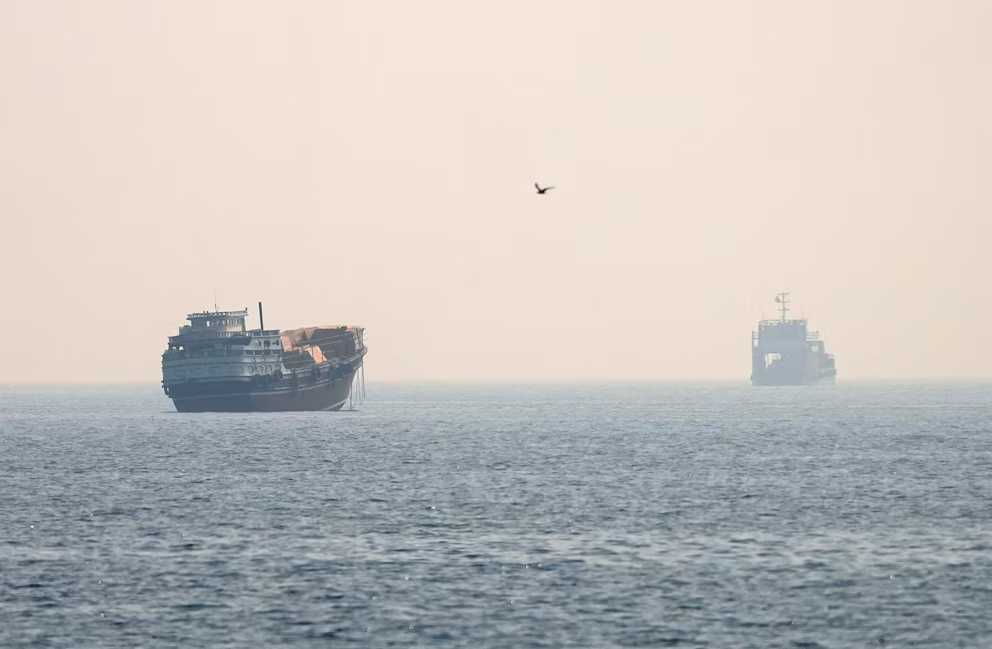
The United States Army rejected this Thursday the claims of the Iranian regime regarding the control of the Strait of Hormuz and maintained that the Islamic Republic has no authority to decide transit through that strategic waterway. The statement came amid a new military escalation between both countries and warnings from Tehran regarding the conditions to fully reopen the passage.
The United States Central Command (CENTCOM), responsible for U.S. military operations in the Middle East, responded to messages disseminated by Iranian state media regarding navigation through the strait, considered one of the most important energy corridors in the world.
“Iran does not control the Strait of Hormuz,” CENTCOM stated in a release published on social media. The agency added that U.S. forces have contributed since the beginning of May to ensuring the safe passage of commercial vessels through that maritime route.
We recommend reading:
According to the military command, its operations allowed for the transit of “more than 800 merchant vessels and 380 million barrels of crude oil”.
More Read
The statement also responded to versions circulated from Tehran that maintain that the movement of vessels can only be carried out through routes established by the Iranian regime until there is a definitive agreement that puts an end to the conflict in the region.
The United States denied that Iran controls the Strait of Hormuz and guaranteed the safe passage of commercial vessels
“Iranian state media claim that transit through the Strait of Hormuz is only permitted via routes designated by Iran,” CENTCOM noted before refuting that version.
More Read

The US statements coincided with new messages from the Iranian Revolutionary Guard. The Navy of that military corps asserted that the recent bombings carried out by the United States have affected the process of gradual reopening of the strait, which connects the Persian Gulf with the Gulf of Oman and constitutes one of the main routes for global oil exports.
Iran also warned that the situation could have consequences for countries whose economies depend on trade passing through that maritime corridor.

The dispute over control of the strait comes after a new round of U.S. attacks against Iranian targets. Washington reported that those operations were launched to protect freedom of navigation following attacks recorded against merchant vessels transiting through the area.
CENTCOM explained that the military actions sought to “further degrade” the Iranian capacity to threaten international maritime traffic and held Tehran responsible for the aggressions against civilian vessels.
President Donald Trump endorsed that position and warned that the United States would respond with greater intensity if attacks against international maritime transport are repeated.
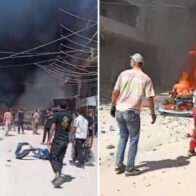
A column of smoke rises after explosions at an unidentified location, following what U.S. Central Command (CENTCOM) described as strikes against Iranian military targets
More Read

“The United States is holding Iran accountable for the recent unjustified aggression against commercial vessels and civilian crews”, indicated the U.S. military command.
The U.S. bombings triggered new Iranian attacks against Kuwait and Bahrain, countries that host U.S. military bases. Kuwaiti authorities reported that they intercepted missiles and drones, while Qatar temporarily activated a security alert before lifting it hours later.
In parallel, the conflict continues to cast doubt on the continuity of negotiations to reach a permanent agreement between Washington and Tehran. Trump stated before the NATO summit held in Turkey that, in his view, the temporary ceasefire was no longer in effect.
“I think it’s over. I don’t want to deal with them,” the U.S. president stated when asked about the understanding previously reached between both parties.
Despite the deterioration of the talks, Trump subsequently maintained that he does not expect an immediate return to a large-scale war and noted that any new episode of the conflict would be brief.
The Strait of Hormuz has historically concentrated a significant portion of global oil trade, and its stability is key to international energy supply. The intensification of military operations in the area keeps the attention of markets and countries that depend on that route for the transport of hydrocarbons.