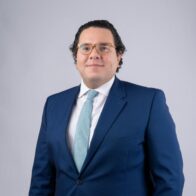

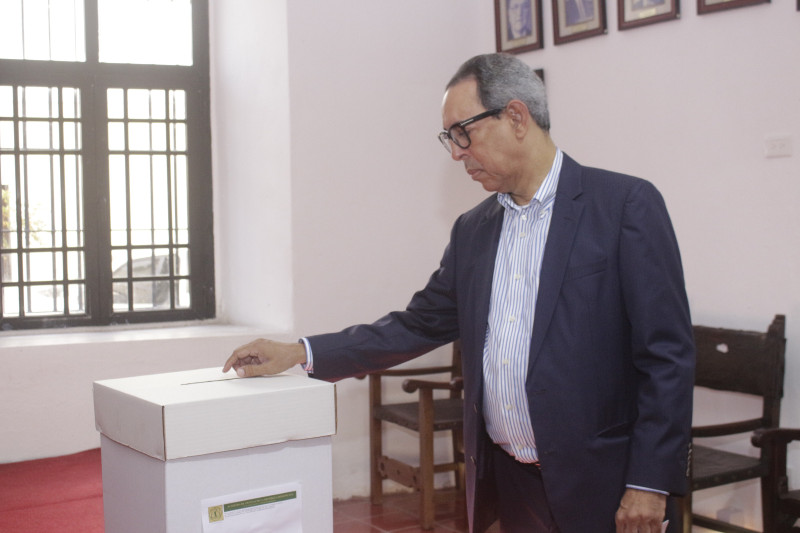
Santo Domingo.- Magistrate Manuel Ramón Herrera Carbuccia, first substitute to the presidency of the Supreme Court of Justice (SCJ) and president of the Third Chamber, formalized his decision not to participate in the performance evaluation process convened by the National Council of the Magistracy (CNM), through a letter addressed to the President of the Republic and the body, Luis Abinader.
In the communication, Herrera Carbuccia explained that his decision is based on the paragraph of article 5 of Regulation no. 2-25 and on paragraph VI of article 56 of the Judicial Career Law (no. 327-98). He also pointed out that his intention to retire had been expressed since 2019, during the first plenary session of the current composition of the Supreme Court of Justice.
You may be interested in: Appeals Court revokes dismissal order and orders trial against Jean André Pumarol
The magistrate maintained that, after completing two seven-year terms on the high court, he considers his cycle at the country’s highest judicial tribunal to be concluded. He stated that his departure responds to a decision made with the same consistency with which, as he expressed, he has conducted his personal and professional life.
With this decision, Herrera Carbuccia joins other judges who have opted for voluntary retirement instead of submitting to the CNM evaluation process, including the president of the Supreme Court, Luis Henry Molina; the second substitute of the presidency, Nancy Salcedo Fernández; and magistrate María Garabito Ramírez.
More Read
Management balance
In an extensive letter, the magistrate recounted some of the cases that marked his career in the Judiciary. Among them, he highlighted his dissenting vote in the process related to Odebrecht, asserting that he was the only judge to express a contrary position without violating the secrecy of the deliberations and warning that the case would conclude without anyone being convicted.
He also recalled his dissent in a decision regarding concubinage adopted by the Joined Chambers of the Supreme Court, considering that a woman with more than three decades of cohabitation only obtained recognition of the rights she could prove through documents and those derived from domestic work. As he indicated, that ruling has been the subject of analysis in various academic investigations.

Herrera Carbuccia also referred to his participation in the Bahía de las Águilas case, a litigation that, he stated, caused attacks on his vehicle, the violation of his home, pressures, legal complaints, and the loss of personal relationships.
More Read

Likewise, he mentioned the review of a file related to a piece of land used for aircraft takeoff and landing operations, the study of which took him more than one hundred hours of work and about a month and a half due to its legal complexity.
The judge also recalled that, upon assuming the role of first substitute to the presidency of the SCJ, he promoted a case file that had remained stagnant for four years and involved former president Hipólito Mejía, which, as he stated, contributed to modifying the jurisprudence regarding the admissibility of appeals against complaints rejected by the presidency of the high court.
He also pointed out that, as president of the Third Chamber, he reactivated a process that had been delayed for almost two years and involved former Minister of Public Works Gonzalo Castillo, in which, he asserted, the Chamber of Accounts had violated due process.
“I leave with a clear conscience”
In the final part of his letter, Herrera Carbuccia expressed that he is leaving the judiciary with the satisfaction of a duty fulfilled.
“I leave with a clear conscience,” wrote the magistrate, who recalled that years ago he was removed for seven years from the presidency of the Third Chamber, a position to which he recently returned for a brief period.
Finally, he highlighted his career as a career judge, which began in the labor jurisdiction of San Pedro de Macorís, as well as his training at the National School of the Judiciary, noting that he concludes his work at the Supreme Court convinced that he acted in accordance with his principles and in the service of justice.