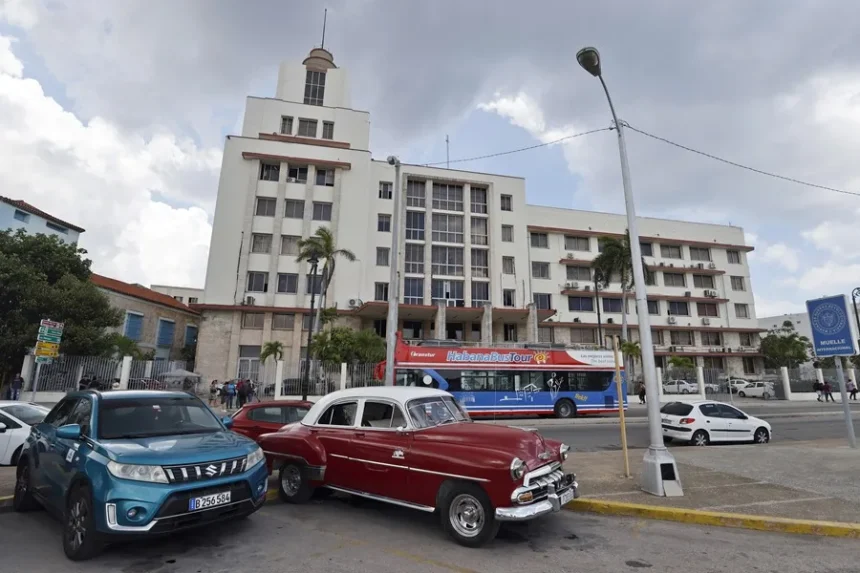
Havana (EFE).– The Government of Cuba denied this Tuesday that the military business conglomerate, Gaesa, is an «opaque structure» that acts «parallel to the State» in its first statement on the matter since the entity was sanctioned by the U.S. a month ago.
“The Business Administration Group is not an opaque structure, nor is it parallel to the Cuban State,” states an executive declaration, disseminated in state media, which responds to some of the main criticisms regarding the company.
The statement also asserts that Gaesa, which is estimated to account for around 40% of the island’s gross domestic product (GDP), is “an articulated response of proven efficiency against the economic siege that has historically tried to suffocate the Cuban Revolution,” in reference to U.S. sanctions.
The Cuban government added that this business conglomerate is “one of the many examples” that over the decades has allowed the island to “resist the permanent aggression of the United States government”.

Creation
Regarding its creation, the official statement referred that it took place in the “height of the Special Period to face the economic war” and mentioned that the economic activity related to the company has allowed for investments to be carried out in thermoelectric plants, hydraulic works, hospitals, and schools.
More Read
“The fruits of this business activity have also been allocated to investments in the Lidio Ramón Pérez (Felton) thermoelectric plant in Holguín, and to the design and consolidation of major hydraulic works, including the East-West and North-South water transfers for the benefit of millions of Cubans,” he detailed.
It also states that all these activities “have been systematically reported to the leadership of the Party (PCC, the only legal one), the State and the Government and, in all cases, subject to maximum control and oversight by the competent authorities and mechanisms.”
This statement contrasts with the response given in an interview with EFE in 2024 by the then Comptroller General, Gladys Bejerano, who asserted that Gaesa as a whole was not audited by this oversight body.

You might be interested in: 65% of Cuba’s territory will be without power this Saturday due to the energy crisis
The Cuban government also asserted that “although their work has not been told enough, it speaks for itself and does so above the state slander concocted from Washington” and insisted that U.S. sanctions seek to “isolate the country diplomatically, commercially, financially, and energetically, make the nation’s sustainability impossible, condition dialogue, and evaluate variants of military aggression.”
The most influential economic actor
Gaesa, founded in 1995 to finance the army during the deep crisis that followed the collapse of the socialist bloc in Europe, is “the most influential economic actor in Cuba,” according to a study by independent Cuban economist Pavel Vidal.
U.S. Secretary of State Marco Rubio stated after Gaesa and its executive president, Ania Guillermina Lastres, were sanctioned on May 7th, that the island is “controlled by a company owned by generals.”
Gaesa’s figures are not public. The American newspaper ‘The Miami Herald’ reported that it had liquid reserves of 14.5 billion dollars in 2024, figures that have been the subject of debate, and a study by the British magazine ‘The Economist’ estimated that, with the collapse of tourism and remittances, the conglomerate currently had barely 1 billion dollars.
What seems to emerge with some certainty is their privileged situation: their balance sheets are not integrated into the national budget, it seems they barely pay taxes, and furthermore, their activity is not audited by the Comptroller General.
Currently, Gaesa has strategic control of tourism, the main source of foreign currency for years on the island, with a large part of the island’s hotels, travel agencies, passenger transport services, restaurants, and marinas. It also has interests in air and land transport, construction, event organization, the financial sector, and logistics.
It also controls the telecommunications monopoly Etecsa, and the Mariel Special Development Zone (ZDEM), Cuba’s main container port. It also has networks of retail stores in foreign currency, gas stations, real estate, and an employment agency.