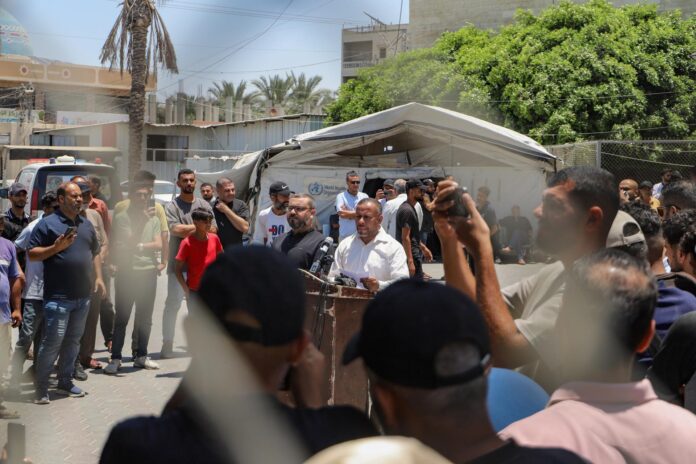
International Desk.- The announcement made this Monday by Hamas that it is dissolving its government and passing the baton to the committee formed by Palestinians that will have to administer the enclave according to the ceasefire agreement, puts an end to 19 years of administration of Gaza by the Palestinian political and armed movement founded in 1987.
On October 9, Israel and Hamas agreed to a ceasefire, mediated by the United States, which ended the war they had been fighting since October 2023, which had begun after the Palestinian organization launched an unprecedented attack on Israel in which it ended the lives of 1,200 people and kidnapped 251.
Read more: Israel kills four Palestinians in Gaza, including an 8-year-old child
The October 2025 agreement established that the government of the Strip would pass from Hamas to the National Committee for the Administration of Gaza (NCAG), under the Donald Trump Peace Board and composed of independent Palestinian technocrats, who would be in charge of administration and public services during a transition period.
The dissolution of the Hamas Administration raised suspicion from both the Peace Board and the media in Israel, where the Islamists’ decision to dissolve has been seen as a symbolic act with no practical relevance.
More Read

The rise of Hamas to power
The Islamic Resistance Movement or Hamas was founded by Sheikh Ahmed Yassin in December 1987, shortly after the outbreak of the First Intifada (Palestinian popular uprising against the Israeli occupation in Gaza and the West Bank).
Although in its origins it was primarily a religious and charitable association, over time it included in its structure a political branch and a military one, the Al-Qassam Brigades, and it became the main Palestinian enemy of Israel, resorting to armed violence and suicide attacks.
More Read

In 2006, following a truce with Israel and the temporary cessation of its armed incursions, Hamas entered politics, ran in the legislative elections in Gaza, and won by an absolute majority—74 of the 132 contested seats—with Ismail Haniyeh at the helm.
The victory ended Fatah’s dominance in the Palestinian Parliament, shifted the internal balance of power, and triggered strong tensions with the Palestinian National Authority (PNA) and its leader, Mahmoud Abbas.
After months of clashes and a failed unity government, Hamas forcibly took control of the Gaza Strip in June 2007 and expelled forces loyal to Fatah, while the West Bank remained under the rule of the PA, controlled by Fatah. That division has persisted until now.
Nineteen years of Government
During its 19 years of government in Gaza, Hamas has maintained its line of confrontation with Israel, which imposed a blockade on the Strip, restricting the entry and exit of people and goods, when the Islamists took power.

The Israeli blockade, with periods of varying intensity, has continued since then, despite the fact that the United Nations and humanitarian organizations have called for its lifting or easing due to the serious consequences suffered by the civilian population.
More Read

Dependent on foreign aid, and with frequent tensions with Arab governments in the region, Hamas has had Iran as its main supporter.
In April 2014, Hamas and Fatah reached a reconciliation agreement that included, among other points, the formation of a national unity government, the reunification of PA institutions in Gaza and the West Bank, and the holding of legislative and presidential elections.
However, the agreement failed to achieve its objectives, the elections were never held, and control of Gaza remained in the hands of Hamas. A new pact, signed in 2022 by the two Palestinian factions, did not fare any better.
Over these 19 years, there have been continuous clashes between Hamas and Israel, some of which triggered major Israeli operations.
The deadliest were Operation Cast Lead, which began in December 2008 and left more than 1,100 Palestinians and 13 Israelis dead; Operation Protective Edge, in the summer of 2014 (2,200 Palestinians and 73 Israelis dead) and Operation Guardian of the Walls, in June 2021 (250 Palestinians and 13 Israelis dead).
The 2023 war
On October 7, 2023, Hamas launched a surprise attack from Gaza against Israel with the firing of 5,000 rockets and the infiltration of militants into Israeli territory by land, sea, and air.
Hamas militants and other Gazan armed groups burst into several towns with gunfire and kidnapped dozens of Israeli and foreign soldiers and civilians with the intention of exchanging them for Palestinian prisoners.
In total, it is estimated that 1,200 people died in the Hamas attack and 251 were kidnapped.
Israeli Prime Minister Benjamin Netanyahu declared a state of war and initiated the worst armed conflict of the Israeli-Palestinian struggle since 1948, which has left more than 73,100 Palestinians dead and 170,000 injured, according to the Gazan Ministry of Health, and has plunged the population of Gaza into an agonizing situation.
Despite the entry into force of the ceasefire on October 10, the bloodshed has continued and, according to Gazan health authorities, more than a thousand people have died and more than 3,400 have been injured in Gaza since then.