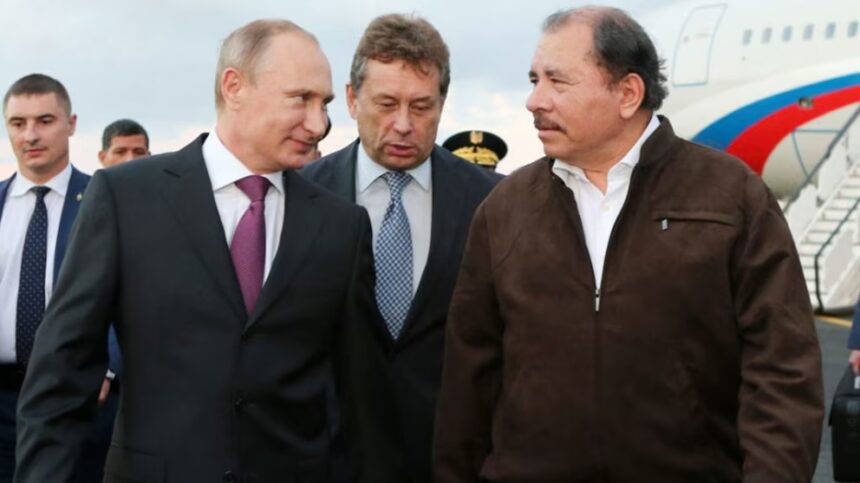
The Nicaragua regime reaffirmed its support for Russia and the figure of Vladimir Putin within the framework of a commemorative date for the Eurasian country, thus consolidating a political and diplomatic alliance that has generated tensions in the region and with Western powers.
In an official letter, co-presidents Daniel Ortega and Rosario Murillo sent their congratulations to Putin for Russia Day, underscoring Managua’s commitment to bilateral cooperation and mutual respect between both nations.
The message, released publicly, highlighted Nicaragua’s “unwavering will” to strengthen the bonds of brotherhood and solidarity with Moscow.
In the text, Ortega and Murillo expressed that they accompany “with joy” the Russian people in the celebration of the anniversary that commemorates the proclamation of Russia’s national sovereignty.
We recommend reading:Nicaraguan regime has exiled 23 critical journalists since 2018
More Read
They added that they share with that country “the sacred principles of dignity, sovereignty, and the construction of a fairer multipolar world.”
The relationship between Russia and Nicaragua
Nicaragua’s stance has remained aligned with Russian interests on the international stage, even in controversial situations. In July 2025, the Sandinista regime expressed its confidence in a Russian victory in the war with Ukraine and recognized the regions of Donetsk, Kherson, Luhansk, and Zaporizhzhia as part of Russian territory.
Managua’s support for Moscow led to the rupture of diplomatic relations with Ukraine, which denounced the Nicaraguan recognition of Russian sovereignty over occupied territories, including Crimea.
Nicaraguan President Daniel Ortega (r) and his Vice President, Rosario Murillo (l), in a file photo. EFE/Jorge Torres
This decision deepened Nicaragua’s international isolation and consolidated its bond with the Kremlin.
The dictator Daniel Ortega, who has been in power for nearly two decades, is considered Putin’s closest ally in Central America. The bond between both countries has historical roots: during the first Sandinista government, Russia provided Soviet weaponry to the Nicaraguan army.

Daniel Ortega strengthened Nicaragua‘s ties with Russia through agreements and decisions that expanded military cooperation and the presence of Russian forces in the country, in a relationship that various media outlets describe as Vladimir Putin‘s closest in Central America.
In June 2022, the National Assembly of Nicaragua authorized the entry of troops, ships, and aircraft of the Russian Armed Forces to operate against crime in the Nicaraguan Caribbean and Pacific, according to Infobae.
The regional projection of that bond was made explicit in December 2023, when Laureano Ortega Murillo, presidential advisor and son of the president, said that Nicaragua should be considered “Russia’s regional platform in all fields,” according to PanAm Post.
More Read

The cooperation also includes a formal pact: in October 2025, Managua and Moscow signed an intergovernmental agreement to strengthen long-term military cooperation, with information exchange and coordination on regional security, according to El Debate.
Logistically, Russia financed and built military infrastructure in Nicaragua, including the delivery of AN-26 aircraft to the Nicaraguan Army, reported CentroAmerica360.
The approach has raised alarms outside the region: the United States views the increase in Russian influence in Central America as a risk to regional security, according to La Prensa Nicaragua.
Russia Day
Russia Day, celebrated on June 12, represents for Moscow the reaffirmation of its national sovereignty. The message of solidarity sent by Managua, as expressed by its highest authorities, underscores the desire to move forward together “waging the battles for peace and a prosperous future for our peoples.”
You can also read:
Political cartoon depicting Daniel Ortega and Rosario Murillo standing on a map of Nicaragua, flanked by flags and symbols of Russia, China, Iran, and Belarus, illustrating their international alliances.
The relationship between Nicaragua and Russia, marked by military and political cooperation, remains a point of attention on the Latin American geopolitical map.
The Sandinista government maintains that the construction of a multipolar world is the path to guarantee the dignity and self-determination of peoples.