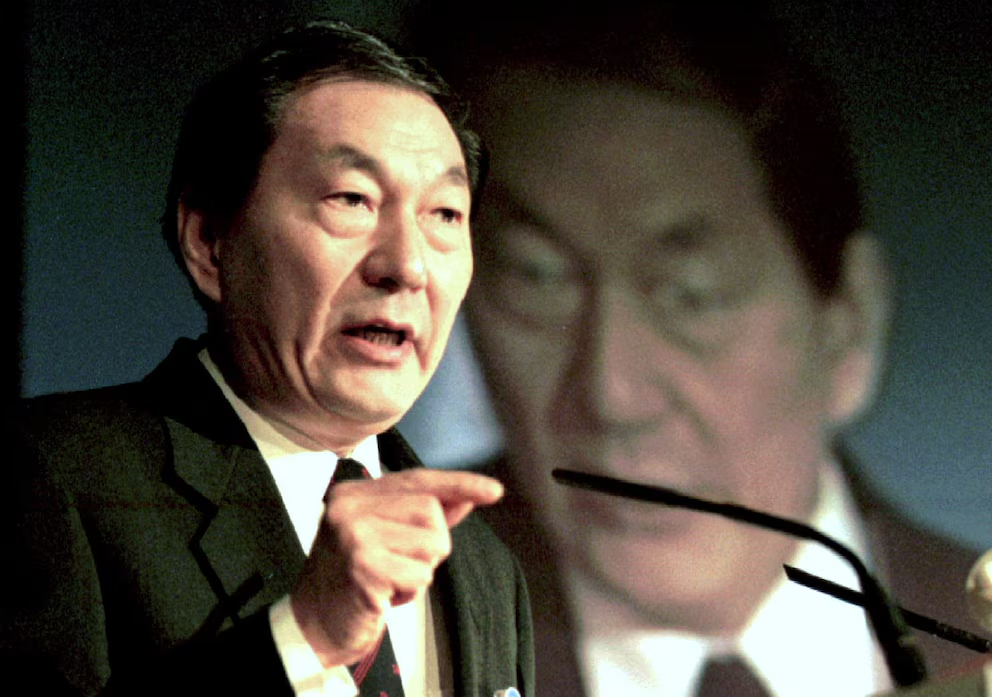
Zhu Rongji, a brilliant economic strategist and key figure in China‘s economic opening to the world, passed away on August 12 in Beijing at the age of 97. The state news agency Xinhua reported that the cause of his death was an illness, citing an obituary issued by the Chinese Communist Party.
Mr. Zhu was China’s “economic czar” for a decade, including five years as premier under President Jiang Zemin, from 1998 to 2003. He negotiated China’s entry into the World Trade Organization, pushed for reforms that revitalized China’s state-run economy, and laid the foundation for another decade or more of rapid economic growth.
Known for his candor and sarcastic humor, his impatience with banquets and protocol, and his intolerance toward lazy and corrupt colleagues, Mr. Zhu was an atypical figure within the suffocating Chinese one-party system. He was widely admired in Western capitals, but less popular in his country’s circles of power. Zhu was intellectually curious and pragmatic. Above all, he was a risk-taker. He pushed for a new dynamism in the Chinese economy by exposing it to competition and market forces. In the process, he left tens of millions of state-owned enterprise employees out of work, but he also dismantled a network of cronyism and corruption that threatened to sink China’s economic boom.
We recommend reading: China imposes loyalty to the CCP over religious faith, according to analyst Luis Zúñiga
Mr. Zhu’s approach earned him many enemies within the system, but ultimately renewed the Communist Party’s grip on power. Succeeding the conservative Li Peng, who played a key role in the violent crackdown on the 1989 Tiananmen Square demonstrations, Mr. Zhu, as prime minister, revitalized his country’s economy and helped rebuild the Communist Party’s image in foreign capitals.
More Read
Several people walk past a shopping mall advertising screen displaying a portrait of former Chinese Premier Zhu Rongji, who passed away on Wednesday, August 12, 2026, in China. REUTERS/Maxim Shemetov
Economic architect
“He was one of the most important economic architects that China has had in the period after 1949,″ stated Nicholas Lardy, a senior fellow at the Peterson Institute for International Economics, who met with Mr. Zhu on numerous occasions. “He did more than anyone to integrate China into the global economy and led a major effort to reform weak state-owned enterprises and the deficient banking system.”
As mayor and later mayor and party chief of Shanghai, from 1988 to 1991, Mr. Zhu laid the foundations for the city’s astonishing modernization. He attracted foreign investors and simplified bureaucracy; furthermore, he promoted the development of the Pudong district, on the east bank of the Huangpu River, and its transformation from a quiet rural area into the financial center of modern China.

Promising to eliminate the large number of approvals required for investment projects, he promised a single-window system. This earned him his first nickname: “Zhu, the one with the stamp”.
He was known for publicly reprimanding officials who did not meet his standards, and his subordinates often referred to him simply as Zhu Laoban, or “Boss Zhu.” Later, his uncompromising approach earned him the nickname Zhu Fengzhi, or “Zhu the Mad.”
As deputy prime minister, his tours of the country generated concern.
In 1994, he had a confrontation with a provincial party boss in the northeastern province of Heilongjiang, and dismissed him on the spot. On another occasion, it is said that a local official flaunted a very expensive cigarette lighter—beyond what someone with his salary could normally afford—and Mr. Zhu fired him immediately for corruption.
His influence on Chinese economic policy—as vice premier, central bank governor, and finally as premier—constituted his most enduring legacy. He was a protégé of supreme leader Deng Xiaoping, who brought him to Beijing in 1991 and described him as someone who “understood economics,” a vital quality in rapidly transforming China.
Two years later, he was granted absolute control over economic policy, at a time when inflation was soaring to 25 percent. Soon, Zhu Rongji rewarded the trust placed in him by Deng Xiaoping, orchestrating a soft landing, imposing greater discipline on banks that had been lending to loss-making state-owned enterprises, cutting public spending, and curbing the growth of the money supply.
More Read
Several people walk past a shopping mall advertising screen displaying a portrait of former Chinese Premier Zhu Rongji, who passed away on Wednesday, August 12, 2026, in China. REUTERS/Maxim Shemetov
Temporary price controls on basic food items helped counter inflationary expectations, indexed savings plans offered protection against inflation and encouraged the population to save rather than immediately spend their wages, and currency devaluation stimulated exports.
Then, he faced the sclerosis that threatened to strangle China’s economic rise. The reform of state-owned enterprises carried out by Zhu Rongji caused more than 30 million employees to lose their jobs, although many found employment in the private sector.

Around 1.5 million civil servants also lost their jobs, as Zhu Rongji attempted, with little success, to reduce an oversized bureaucracy. With the support of President Jiang Zemin, who tried to curb rampant corruption in the military, Zhu Rongji strove to remove the armed forces from their commercial businesses and pushed for tax collection for the central government.
His most enduring achievement may have been China’s entry into the WTO in 2001. There were years of tough negotiations with the United States, during which he was often accused at home of selling out to the Americans. But, ultimately, Mr. Zhu negotiated terms that laid the foundation for years of export-led growth.
Even so, Mr. Zhu acknowledged that his work was incomplete when he retired in 2003, at the age of 75, and claimed not to have addressed the growing gap between China’s flourishing east coast cities and its much poorer rural interior.
Dynastic background
It is said that Mr. Zhu’s family was descended from Zhu Yuanzhang, the first emperor of the Ming dynasty, founded in the 14th century, and they were large landowners in the vicinity of Changsha, in Hunan province.
Mr. Zhu’s father passed away before he was born in Changsha on October 1, 1928, and he was a teenager when his mother died. He was raised by an uncle who had three daughters and one son. Supposedly, the uncle was so poor that they could only afford to send their two sons to school.
Mr. Zhu made the most of his opportunity. He was top of his class and studied electrical engineering at the prestigious Tsinghua University in Beijing. In 1949, the year of the founding of the People’s Republic of China, he joined the Communist Party.
Former Chinese Premier Zhu Rongji leaves after the opening of the 19th National Congress of the Communist Party of China at the Great Hall of the People in Beijing, China. REUTERS/Jason Lee
At Tsinghua, he was elected class president and chairman of the student committee. There he met his future wife, Lao An, with whom he shared a passion for Peking opera. They married in 1956 and later had a son and a daughter, who were educated in the United States and achieved great prominence in the Chinese financial sector.
In 1957, Mr. Zhu was caught up in one of the purges by Chinese Communist Party Chairman Mao Zedong. Reportedly, Mr. Zhu gave a short speech criticizing the party leadership and praising the reforms taking place in communist-controlled Hungary and Yugoslavia. He was labeled a “rightist,” interrogated for months, expelled from the Communist Party, and sent to a re-education camp in the countryside (to perform manual or administrative labor).
During the bloody Cultural Revolution, Mr. Zhu was banished again to the countryside in 1970. There he raised pigs and grew wheat, but he also found time to continue learning English.
Dr. Zhu’s career took off after Mao’s death in 1976. He was rehabilitated by Deng, who had suffered a similar fall from grace under Mao’s rule. Under Deng’s tutelage, Mr. Zhu rose rapidly through the party ranks until he came to lead Shanghai.
There, one of his first actions was to reprimand local tourism officials for the state of the city’s public restrooms. “How is Shanghai expected to attract 900,000 foreign tourists if they cannot find a clean bathroom?”, he asked the officials, before ordering them to clean them thoroughly.
In June 1989, following the violent crackdown on the Tiananmen Square protests in Beijing, he faced an even greater challenge. Thousands of students were blocking the roads in Shanghai and workers were not showing up for their jobs. Instead of ordering a crackdown, he gave a televised speech that calmed tempers, calling the students patriots instead of “counter-revolutionaries,” as the protesters in Beijing had been labeled. He pledged not to send armed police and urged the protesters to “preserve the livelihood and production of Shanghai” by returning home.
“Historical facts cannot be covered up by anyone,” declared Zhu. “The truth always comes to light.” The anger dissipated and the protesters dispersed.
In 1990, during a tour of the United States, a New York Times journalist dubbed him “the Gorbachev of China,” in reference to the reformist Soviet leader Mikhail Gorbachev. However, this recognition earned him considerable controversy in his country, a recognition that he angrily rejected. Mr. Zhu never expressed a desire to replace the Communist Party regime with a Western-style democracy, but he seemed genuinely frustrated by officials who enriched themselves illegally, and he urged journalists to be faithful to their profession and to expose “the dark side of society.”
After his retirement, Mr. Zhu wrote several best-selling books, played the huqin, a traditional string instrument, and built a reputation as one of China’s most generous philanthropists, donating millions of dollars in royalties to a foundation dedicated to improving education in poor rural areas.