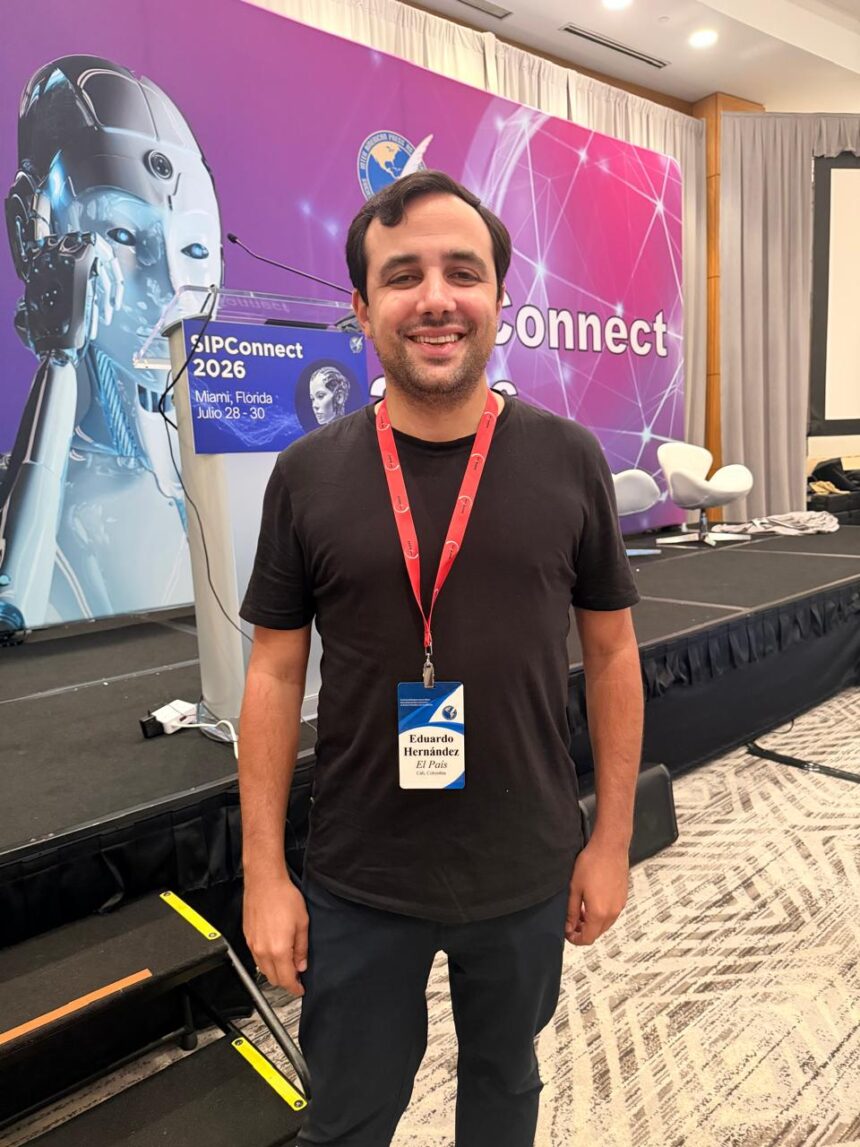
Eduardo Hernández, CEO of El País de Cali, shared at SIP Connect 2026 the challenges of modernizing a media outlet with 76 years of history
Miami.- The digital transformation of media outlets does not depend solely on technology, but also on a profound change in newsroom culture. This was stated by Dominican Eduardo Hernández, CEO of El País in Cali (Colombia), while sharing the modernization experience he is leading at one of the country’s most traditional newspapers during his participation in the panel “AI Adoption in Media: Lessons and Challenges,” held as part of SIP Connect 2026.
Hernández explained in an exclusive interview for De Último Minuto that taking over the management of a media outlet with a 76-year history meant facing significant resistance to change, especially due to the decision to stop daily printing and concentrate the print edition only on weekends, a strategy aimed at strengthening digital production without abandoning the value of the printed newspaper.
“It is a complex process, but at the same time very fun and full of challenges. The first part has been a cultural change, because it was a newsroom very focused on the printed newspaper. Moving to printing only on weekends generated a lot of resistance initially,” he noted.
We recommend reading:
More Read

The executive explained that the measure was not solely due to economic reasons, but also to the need to reorganize work dynamics so that journalists can focus on the development of digital products.
“When a journalist has to work for the web and then for print every day, they end up dividing their capacity. By reducing the daily print edition, we free up time and capacity to develop the digital products we are betting on,” he/she indicated.
AI also demands leadership and trust
More Read

During the conversation, Hernández acknowledged that the incorporation of artificial intelligence tools generates uncertainty among journalistic teams, which is why he considered a process of training and leadership essential to understand the true role of this technology.
“When you talk about artificial intelligence, many immediately think: ‘what is going to happen to me?’. That is why we must evangelize, educate, and lead that process so that the change spreads throughout the entire organization,” he expressed.

He added that AI should not only be integrated into editorial routines, but also become an opportunity to develop new commercial products that strengthen the sustainability of media outlets.
A Dominican at the helm of a historic Colombian newspaper
Hernández explained that his arrival at El País de Cali arose from a business opportunity linked to his technology venture ibiDs, a platform developed in the Dominican Republic to facilitate public procurement processes, with the intention of expanding it to the Colombian market.
That juncture ended up connecting two areas that have marked his professional trajectory: technology and the media.
More Read
“I had already gone through different facets within the media world and this opportunity allowed me to close that cycle from the management of a newspaper with a huge tradition,” he commented.
The future of journalism
After participating in the conferences and panels at SIP Connect 2026, Hernández stated that one of his main conclusions is that artificial intelligence will be an inseparable part of the industry’s future, although he emphasized that there is an element that no technology will be able to replace.
“The future of media is inexorably linked to artificial intelligence, but also to journalists with good sources. A journalist who builds relationships, who can sit down to talk with their sources and obtain first-hand information, that is irreplaceable by AI,” he stated.
With that reflection, the Dominican executive summarized one of the main consensuses of the meeting organized by the Inter American Press Association: technological innovation will transform newsrooms, but the differential value of journalism will continue to be credibility, human judgment, and the ability to build original information.