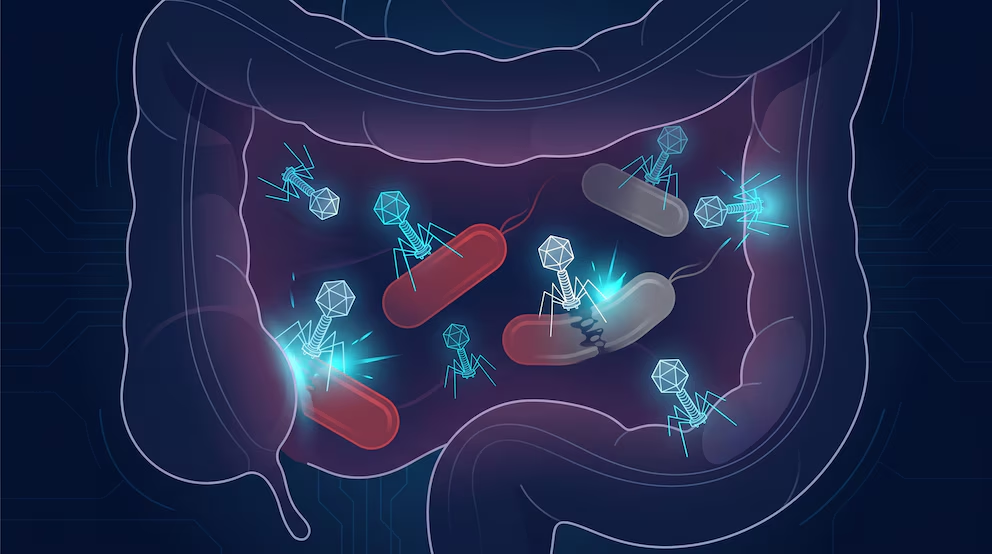
There is a type of virus present in nature that does not harm human cells and can deactivate bacteria that cause chronic inflammation.
Researchers at McMaster University, in Canada, are developing a phage therapy technique: they are using the virus to treat inflammatory bowel disease and have already obtained results that could change the way we think about the disorder. They published their work in the journal Science Translational Medicine, edited by the American Association for the Advancement of Science.
The research was led by Kyle Jackson, Zeinab Hosseinidoust and Elena Verdu, from the Michael G. DeGroote Institute for Infectious Disease Research and the Farncombe Family Digestive Health Research Institute, in Hamilton, Ontario, which are part of McMaster University.
Scientists highlighted that the virus also enhanced the effect of a common corticosteroid at a lower dose than the standard one, which could reduce the risk of side effects in patients.
“This work presents a very interesting example of the application of phages as targeted therapies for specific bacteria relevant in intestinal inflammation,” stated Dr. Karina Mariño, a CONICET researcher at the Laboratory of Functional and Molecular Glycomics of the Institute of Biology and Experimental Medicine (IBYME), when consulted by Infobae.
More Read

“Its specificity is promising in terms of treatment safety. In terms of efficacy, an important factor to consider is the immune system’s response to the phage, which could considerably reduce it,” he/she specified.
“Furthermore, it remains to be established how frequent the specific strain of adherent-invasive Escherichia coli is in patients with Crohn’s disease, and whether resistance to treatment could develop. As with any proposal based on experimental models, safety and efficacy must be evaluated in clinical trials,” emphasized Dr. Mariño, who was not involved in the study published in the journal Science Translational Medicine.
We recommend reading: DR Congo raises Ebola death toll to 625 and confirmed cases to 1,792
More Read

When the gut becomes a battlefield
A fecal matter analysis could identify patients with active Crohn’s disease as the most likely candidates for phage therapy (Illustrative Image Infobae)
Inflammatory bowel disease, or IBD, is a chronic condition of the digestive tract that includes Crohn’s disease and ulcerative colitis.
Current treatments lose efficacy over time or require increasingly higher doses, which increases the risk of adverse effects. The problem is that none of them attack the microbial causes that trigger the outbreaks.
A group of bacteria called adherent-invasive Escherichia coli, or AIEC, is linked to the most acute episodes of Crohn’s disease. These bacteria attach to the intestinal walls, invade them, and survive inside immune system cells, which triggers inflammation.
Dr. Verdu explained that to identify them, it is necessary to evaluate “their behavior, such as their ability to adhere to and invade intestinal cells and persist in immune cells.”
Antibiotics do not ideally resolve inflammatory bowel disease because they alter the microbiome and do not distinguish between harmful and beneficial bacteria (Illustrative Image Infobae)
More Read


Antibiotics are not an ideal solution because they do not distinguish between harmful and beneficial bacteria, and their frequent use can alter the microbiome, that is, the set of microorganisms that inhabit the gut.
For this reason, the team opted for bacteriophages, which are viruses that infect bacteria with high precision without touching human cells. Their goal was to evaluate whether that therapy could reduce inflammation without damaging the microbial ecosystem and be combined with an existing drug.
The virus that turns off the inflammation switch
The HER259 bacteriophage reduced inflammation in acute and chronic colitis by deactivating FimH, a key protein of AIEC bacteria.
The team worked with germ-free mice, raised without any bacteria in their bodies, into which they introduced strains of Escherichia coli from patients with Crohn’s disease.
They identified the bacteriophage HER259, capable of selectively attacking AIEC bacteria, and administered it orally. They also tested its combination with budesonide, a common corticosteroid for IBD, at a lower dose than the standard.
The HER259 virus reduced inflammation in acute and chronic colitis without completely eliminating the bacteria. What it did was deactivate FimH, the “molecular hook” that allows AIEC to attach to the intestinal wall and trigger the inflammatory response.
Hosseinidoust described it this way: “The bacteria were still there, but they lost the traits that drive inflammation. We like to think of it as pulling some of their teeth. The bacteria can no longer do as much damage.”
Upon suspending the treatment, the bacteria regained their inflammatory capacity and the colitis reappeared, which indicates that the administration must be continuous.
The combination of HER259 with a sub-therapeutic dose of budesonide produced results equivalent to higher doses of the drug alone, the first time such synergy between a phage and a non-antibiotic drug has been documented.
The HER259 bacteriophage reduced inflammation in acute and chronic colitis by deactivating FimH, a key protein of AIEC bacteria.
Furthermore, a detectable fecal marker was higher in patients with active Crohn’s than in healthy individuals, which opens the possibility of identifying those who would benefit most through stool analysis.
The researchers acknowledged that the bacteria used as a model is not present in all IBD patients, and that the host’s immune response to the phage was not analyzed, an aspect pending before any application in humans.
The next steps include evaluating more bacterial strains and developing phage combinations. Verdu noted: “If we can identify which patients have that harmful bacterial function, we could, in the future, intervene with a therapy specifically targeted at reducing that activity.”