Honduras began this week a new evaluation by the Financial Action Task Force of Latin America (GAFILAT), a regional body associated with the Financial Action Task Force (FATF), which will spend 18 months reviewing the country’s effectiveness in preventing and combating money laundering and terrorist financing.
The process will not be focused on a specific institution, but rather on the entire national system in charge of detecting, investigating, sanctioning, and preventing resources derived from illicit activities from entering the formal economic system.
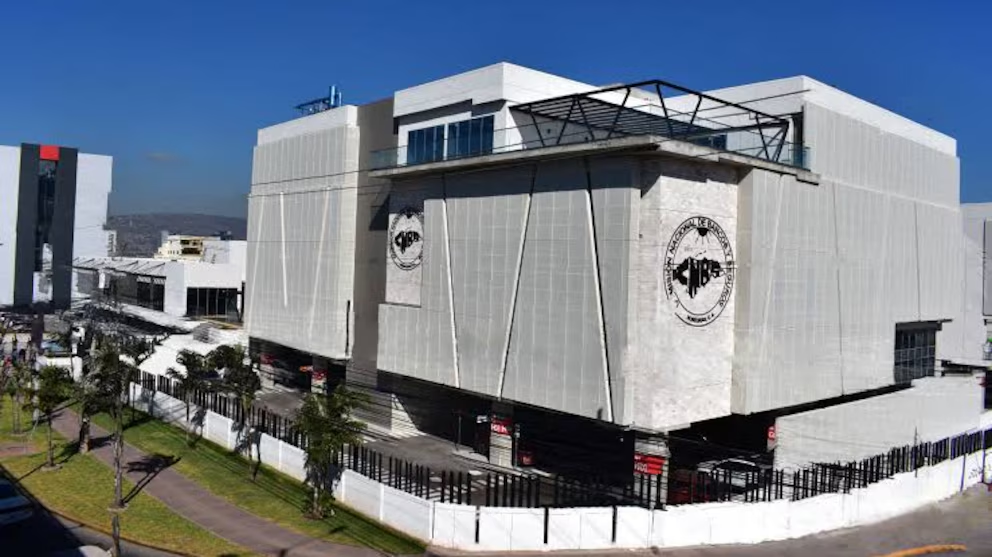
The commissioner of the National Banking and Insurance Commission (CNBS), Gustavo Solórzano, explained that the evaluation will be carried out by specialists from GAFILAT and will cover public institutions, supervised private sectors, and organizations linked to the prevention of financial crime.
“It is not that the National Banking and Insurance Commission is being evaluated, the entire institutional framework of the country is being evaluated,” Solórzano pointed out when referring to the scope of the process.
We recommend reading:
More Read
GAFILAT evaluations are part of an international mechanism used in Latin America to determine if countries have sufficient tools to confront the movement of money generated by criminal organizations.
First institutions
During these types of processes, experts not only review existing laws, but also the way in which institutions apply those rules and the results obtained in practice.
More Read

Among the aspects that will be analyzed in Honduras are the authorities’ capacity to identify suspicious operations, coordination between institutions, financial investigations, judicial processes, and the recovery of assets linked to illicit activities.
One of the central points of these evaluations is to determine whether a country has an effective system to prevent groups dedicated to drug trafficking, corruption, extortion, or other crimes from using banks, companies, or different economic sectors to hide the origin of their resources.
Commissioner Gustavo Solórzano states that the process will evaluate the entire Honduran institutional framework. (photo: Courtesy Confidencial HN)
As part of the initial agenda, the evaluation team will hold a first meeting this Tuesday, August 4, with the Interinstitutional Commission for the Prevention of Money Laundering (CIPLAV), in which representatives from different institutions related to this matter will participate.
Meeting with government authorities
During the process, the evaluators will have meetings with authorities, supervisory bodies, financial sectors, and representatives of the private sector to learn how the Honduran structure for the prevention of money laundering works.
Among the sectors that will be consulted is the Honduran Council of Private Enterprise (Cohep), as well as representatives of financial activities and other sectors considered relevant within the prevention system.
More Read


The international review also includes meetings with the highest authorities of the Honduran State. The agenda includes meetings with the President of the Republic, the Attorney General of the State, the president of the National Congress, and representatives of the Supreme Court of Justice.
The participation of these institutions is due to the fact that combating money laundering requires coordination between different areas of the State: from the creation of laws, financial supervision, and criminal investigation, to the prosecution of cases and the application of sanctions.
According to the National Banking and Insurance Commission, the evaluation will continue over the coming months with data collection, technical meetings, and analysis of results.
What GAFILAT reviews
In other processes carried out in Latin America, GAFILAT has evaluated the capacity of countries to confront the economic flows generated by criminal organizations.
Specialists analyze two major components: technical compliance with international standards and the effectiveness of the national system.
GAFILAT brings together 18 Latin American countries that implement the 40 international recommendations to combat money laundering and terrorist financing. Credit: Facebook / Financial Action Task Force of Latin America – Gafilat
The first point reviews whether there are laws, regulations, and institutions in place to prevent money laundering and terrorist financing. In the second aspect, it is studied whether those tools actually produce results.
For this reason, evaluators observe indicators such as investigations initiated, convictions obtained, asset seizures, international cooperation, and the authorities’ capacity to track the money used by criminal structures.
The result of this evaluation will have implications for Honduras, because these analyses influence the international perception of the strength of the financial system and the country’s capacity to confront economic crimes.
In similar processes carried out in other countries, the results have led to legal reforms, the creation of new institutional capacities, and action plans to correct detected deficiencies.
The findings collection stage is scheduled for May, while the process will conclude in December 2027 with the presentation of the final results.
During that period, Honduras must demonstrate the capacity of its institutions to prevent resources derived from criminal activities from being incorporated into the national economic system.