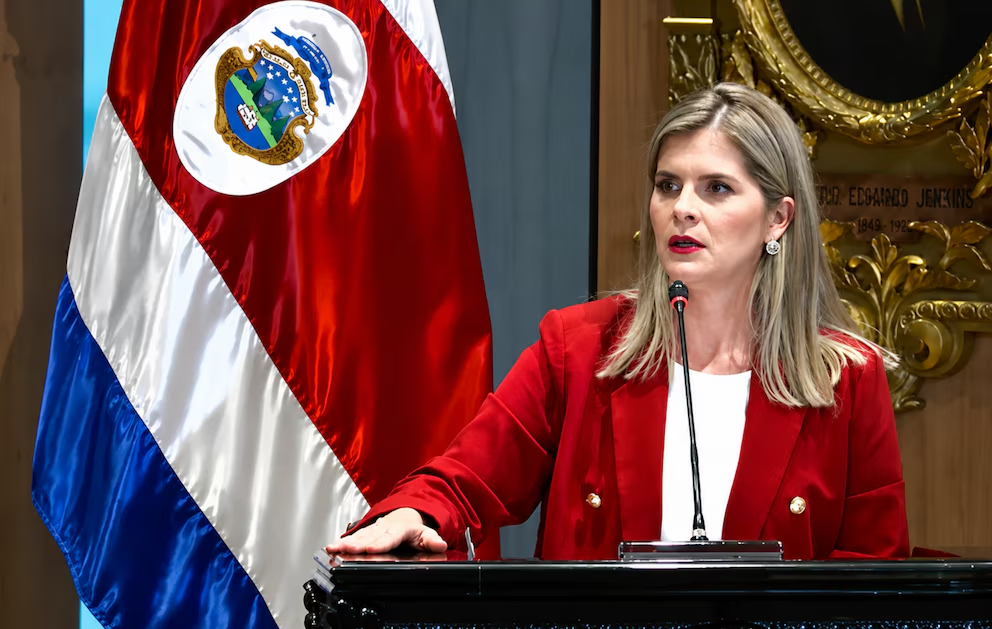
The President of the Republic, Laura Fernández, presented this Monday to the Legislative Assembly a second package of six bills with which she intends to strengthen the fight against organized crime, streamline judicial processes, and toughen the State’s tools against crimes such as drug trafficking, illegal mining, and contract killing.
During a presentation lasting more than an hour, the president assured that the initiatives are the result of the work carried out by the Elite Force team, an entity that, as she explained, analyzes the country’s security situation weekly to identify legal loopholes that hinder the prosecution of crime.
Fernández stated that Costa Rica is facing criminal organizations with greater operational capacity and resources than in previous decades, which is why he considered it essential to update legislation that he described as “obsolete” in the face of new criminal modalities.
“We are not going to stop in the national crusade against organized crime. We are not going to stop in the all-out war against drug trafficking,” he stated during his speech.
We recommend reading:
Reforming the criminal process to accelerate justice
The first project proposes modifying the Criminal Procedure Code to eliminate the preliminary hearing and replace it with a single pre-trial hearing.
As the president explained, the intention is to reduce the duplication of procedures, shorten the resolution times for files, and lower the operating costs of the Judiciary, without affecting due process guarantees.
Fernández maintained that there are currently criminal cases that take so many years to reach trial that some witnesses even forget details of the events under investigation.
More Read

During that section, he also criticized the Judiciary for, as he stated, focusing on requesting greater financial resources instead of promoting reforms to make the justice system more efficient. Likewise, he questioned the absence of Court representatives at a previous meeting called to analyze the initiatives.
The president defended the reforms as a response to the new forms of criminality facing the country. Source: Presidency of the Republic
Extradition for more serious crimes
Another of the main proposals consists of a constitutional reform to expand the grounds for the extradition of Costa Ricans for crimes linked to transnational organized crime.
The initiative contemplates including crimes such as international drug trafficking, terrorism, money laundering, human trafficking, illicit arms trafficking, organ trafficking, contract killing, homicides related to criminal structures, cybercrime, and participation in international criminal organizations.
The president clarified that extradition would remain an exceptional measure, subject to the resolution of the Costa Rican courts and compliance with the principle of double criminality, that is, that the conduct must be considered a crime both in Costa Rica and in the requesting country.
The Government proposes to expand the crimes for which a Costa Rican could be extradited in exceptional cases.


Electronic ankle monitors for those who obtain prison benefits
One of the projects that Fernández described as a priority proposes the mandatory use of electronic monitoring devices for convicted persons who receive sentence execution benefits and are able to leave prison before fully serving their sentence.
The president used the case of Alejandro Arias Monge, alias “Diablo,” as an example, stating that if similar legislation had existed years ago, the alleged criminal leader would not have remained a fugitive for a decade.
As explained, the objective is to replace mechanisms such as the obligation to sign in periodically with a permanent surveillance system using electronic ankle monitors that allows for the beneficiary’s location to be known and reduces the risk of recidivism.
The proposal also aims to strengthen controls over execution judges and tighten the requirements for accessing trust-based regimes.
Fernández was accompanied during the presentation by Pablo Bertozzi, director of the DIS; Gabriel Aguilar, Minister of Justice and Peace; Gerald Campos, Minister of Security and Rodrigo Chaves, Minister of the Presidency. Credit: Presidency of the Republic screenshot
Toughen penalties for illegal mining
The fourth project is aimed at combating illegal mining, particularly in Crucitas, San Carlos.
The reform would increase prison sentences for illegal mineral extraction, raise penalties for those who finance or promote these activities, and allow for the seizure of machinery, money, and assets used in the illicit activity.
Fernández asserted that current penalties are insufficient to combat this phenomenon and stated that there are individuals arrested on multiple occasions for illegal mining who quickly regain their freedom due to the low penalties provided for in current legislation.
Among the initiatives is the increase of penalties to combat illegal mining in Costa Rica
Child support and new police structure
The fifth project proposes replacing physical detention with electronic monitoring for child support debtors, so that they can maintain employment and generate income to fulfill their obligations, under judicial supervision.
However, the president clarified that those who fail to comply again or tamper with the device would lose the benefit and be sent to the penitentiary system.
Finally, the sixth project proposes modifying the hierarchical structure of police forces by restoring traditional ranks such as colonel, lieutenant colonel, major, captain, lieutenant, and sergeant, in addition to establishing public competitions for promotions and academic and experience requirements to hold command positions.
Fernández maintained that the initiative seeks to strengthen the police career, eliminate discretionary appointments, and standardize the nomenclature used by Costa Rican police forces with that employed by international police bodies.