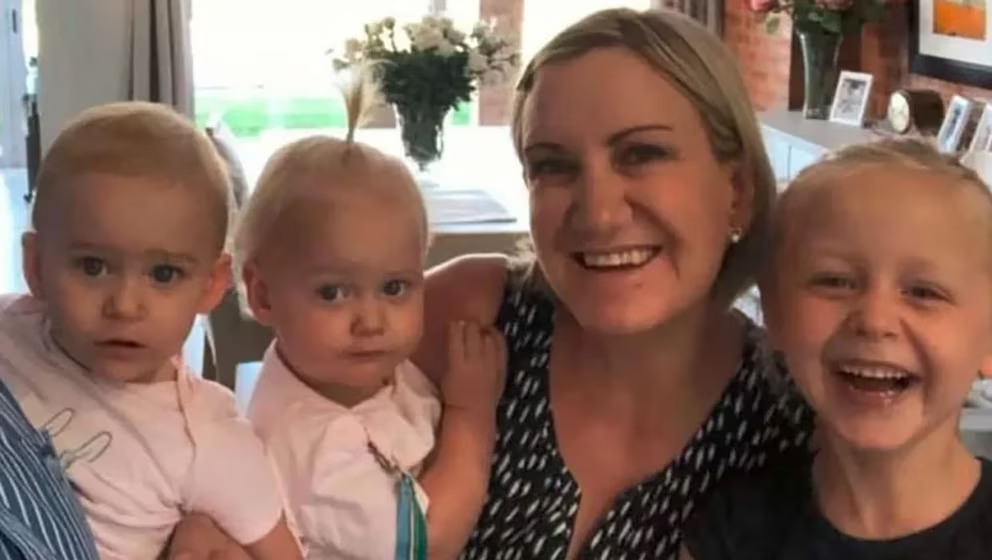
On the night of September 16, 2021, Graham Dickason returned to his home in Timaru, New Zealand, shortly before 10 p.m. and found his wife in the kitchen, staggering and with an expression that, as he himself stated, he had never seen on her before.
When he asked her what had happened, Lauren Dickason replied with only three words: “It is too late.” What Graham discovered when he ran to his daughters’ rooms (Liane, six, and twins Karla and Maya, two) shocked New Zealand.
That night a doctor mother, with no criminal record, had suffocated her three daughters, weeks after the family emigrated from South Africa.
The Dickason case is the portrait of a woman who carried a severe mental illness for years, who made decisions that, according to defense psychiatrists, completely clouded her judgment, and who today awaits from prison the result of an appeal that could change the murder verdict that convicted her in 2023.
Lauren and Graham met in 2005 in Pretoria, South Africa
More Read

We recommend reading:
A family built with effort
Lauren and Graham met in 2005 in Pretoria, South Africa. She was a doctor. He, an orthopedic surgeon. They married a year after their first meeting and settled in The Wilds Estate, on the outskirts of the South African capital.
Motherhood did not come easily. The couple went through 17 failed rounds of in vitro fertilization. In 2013, Lauren became pregnant, but the baby, Sarah, was born prematurely at 18 weeks and died shortly after. That blow marked a turning point in Lauren’s mental health, who was diagnosed with major depression with an anxiety component and an intermittent mood disorder. She stopped practicing medicine actively.
More Read

Years later, the couple turned to donor eggs. In 2014, Liane was born. In 2018, Lauren became pregnant with twins, and in 2019, Karla and Maya arrived. Karla was born with a cleft lip and required several surgeries. Maya had a habit of carrying toys in little bags, which earned her the nickname “the bag lady.” Liane, the eldest, was protective of her younger sisters.
Family friends in Pretoria described Lauren as an exemplary mother. Natasja le Roux, a close friend, remembered her as one of the kindest people she ever met. Graham, for his part, stated that Lauren never treated the girls conceived with donor eggs any differently than she would have treated biological daughters.
According to the confession Lauren gave to the police after her arrest, something inside her “snapped” while the girls were being rowdy
The relocation and the silent break
The decision to emigrate to New Zealand arose when Graham secured a position at Timaru Hospital. Plans were delayed by the COVID-19 pandemic, but in August 2021 the family finally boarded a flight. Liane was six years old and the twins were two.
After completing the two weeks of mandatory hotel quarantine, the Dickasons were released on September 11 and began settling into their new life. Graham integrated quickly into the hospital. The community welcomed them warmly.
On September 15th, Liane had her first day of school. The next day, the twins started kindergarten. That afternoon, Lauren took the three girls to the local botanical garden. A minor incident—another child photographed the girls without permission—shook Lauren, who gathered her daughters and returned home earlier than planned. According to later testimonies, that episode led her to question aloud whether the move had been the right decision.
More Read

That same night, Graham went out for a work dinner around 7 p.m. He said goodbye to Lauren and the girls. When he returned, the house was silent.
The first officers to arrive at the scene found cut ropes on the floor and Lauren semi-conscious in Liane’s room, with superficial cuts on her arm
What happened that night
According to the confession Lauren gave to the police after her arrest, something “snapped” in her while the girls were being rowdy. She went to the garage, grabbed some ropes, and told her daughters they were going to make necklaces. Then she told them she was dying and could not leave them behind. She first immobilized Karla, whom she had described as “horrible” in recent days. Then Liane, who asked her why she was doing that to her. Finally, Maya. When the girls did not die immediately, she suffocated them with a towel and blankets. She then attempted to take her own life with tramadol and a razor.

The first officers to arrive at the scene found cut ropes on the floor and Lauren semi-conscious in Liane’s room, with superficial cuts on her arm. The three girls were in their beds, beyond any possibility of resuscitation. Lauren was taken to Timaru Hospital. The next day, after being discharged, she was charged with the triple homicide.
Graham alerted the neighbors and asked a colleague to call the police, as he did not know the emergency number for New Zealand. Days later, on September 23, he spoke publicly for the first time at a candlelight vigil in front of the family home. He said he had forgiven Lauren and asked those present to do the same, and described her as another victim of the tragedy. Hundreds of people gathered in Timaru. A parallel vigil was held in Pretoria.
A history of ignored alarms
What the trial revealed was that Lauren’s collapse was not sudden. Her mental health issues dated back to her adolescence, marked by anxiety, depression, and perfectionism. After Sarah’s death, her condition worsened. As a doctor, she prescribed her own antidepressants, a legal practice in South Africa.
After Liane’s birth, depression affected her ability to parent. In text messages to friends, Lauren made references to strangling her daughter and expressed fear of hitting her too hard. Her condition improved for a time, but with the arrival of the twins, it deteriorated again. On two occasions, she told Graham that she could “do something” to the girls. In May 2019 and July 2021, Lauren sought professional help and seemed to recover. Graham stated that he never believed she would actually act on it.
Before emigrating, Lauren stopped taking her medication, worried that it might affect her residency application. She reported feeling better for a while. But the stresses of the move wore her down. She stopped eating and sleeping regularly, withdrew from the family environment, and began to feel that the girls preferred him.
In private messages sent during the days leading up to the crime, Lauren described the twins as “terrifying,” recounted days of screaming and biting, and wondered how other parents made it look easy. She also conducted internet searches on methods for medicating children, the most recent just a month before the events. Lauren pleaded not guilty to the three counts of murder.
The trial and the clash between psychiatrists
The judicial process began on July 17, 2023, in Christchurch. The defense proposed a strategy based on insanity and infanticide. Lauren pleaded not guilty to the three counts of murder.
Prosecutor Andrew McRae argued that, beneath Lauren’s genuine mental health issues, there was resentment toward her daughters, whom she viewed as an obstacle to her marriage. He presented messages in which Lauren complained that the girls had drained the joy from her relationship, and pointed to internet searches as evidence of premeditation.
The defense, led by Kerryn Beaton, constructed an opposing argument. Lauren was a loving mother who, in the midst of a severe mental crisis, believed she had to take her daughters with her when she died, due to a logic distorted by illness.
The most tense debate occurred among the psychiatric experts. Dr. Susan Hatters Friedman and two other defense experts concluded that Lauren was in a psychotic and delusional state at the time of the events, that she acted out of love and not malice, and that she met the legal criteria for insanity. Dr. Erik Monasterio, also called by the defense but with a different conclusion, maintained that Lauren suffered from depression but not psychosis, and that she did not reach the threshold of insanity. The prosecution’s psychiatrist, Dr. Simone McLeavey, testified that Lauren understood her actions and was motivated by anger and a need for control, not altruism.
After deliberating, the jury reached a majority verdict of 11 to 1. They found her guilty of murder in all three cases. Lauren wept silently as she left the courtroom.
The sentence and the pending appeal
On June 26, 2024, Justice Cameron Mander sentenced Lauren Dickason to 18 years in prison, with three concurrent sentences and no minimum non-parole period. Mander ruled out life imprisonment, considering it “manifestly unjust,” given that her severe mental illness was not just a contributing factor but the direct cause of her actions.
Lauren was initially referred to a special care unit for patients with mental disorders, in accordance with New Zealand mental health legislation. Following the sentencing, she issued a statement in which she said that she loved her daughters with all her heart, that she had failed them, and that she took responsibility for taking their lives. “I sleep with three teddy bears embroidered with my daughters’ names to remember all the wonderful hugs they used to give me,” she wrote.
In July 2024, Lauren filed an appeal against her murder conviction. As reported by Radio New Zealand (RNZ), the hearing before the Court of Appeal was set for three days in Wellington starting February 9, with the argument that there was a “miscarriage of justice.” Her lawyer must specify the grounds in a formal submission.
Lauren will be eligible for parole once she serves one-third of her sentence, around September 2027.
Lauren’s parents, Wendy and Malcolm Fawkes, asked after the verdict that society learn to recognize the symptoms of postpartum depression. A call that, in the context of this case, takes on a dimension that goes beyond the family drama
The appeal hearing, scheduled for February of next year in Wellington, will determine whether the murder verdict stands or if the case returns to the debate over the boundaries between criminal guilt and mental illness.