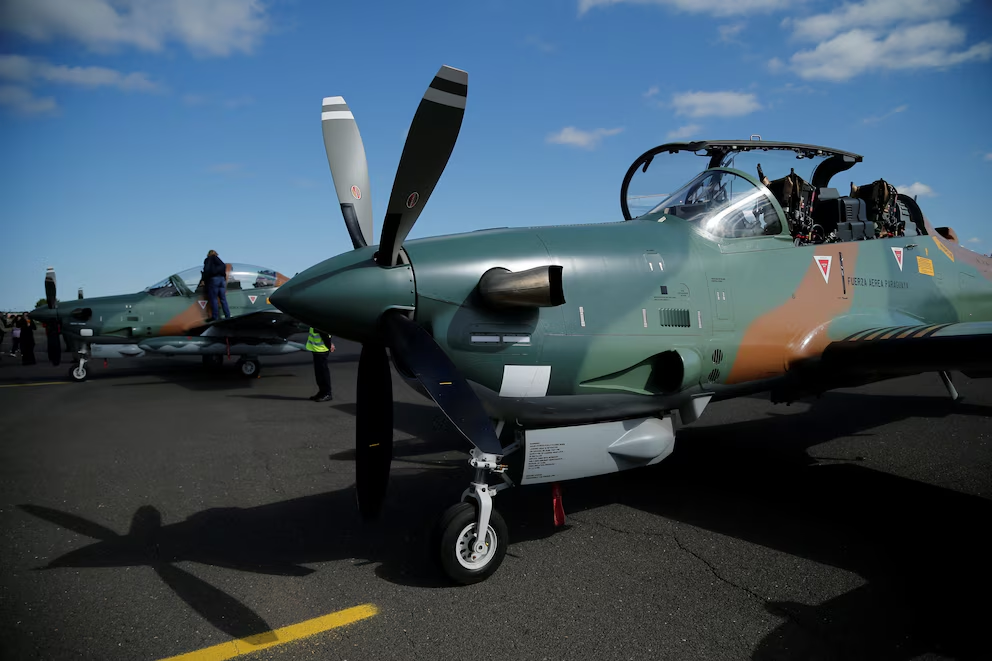
The Uruguayan Air Force has begun incorporating its first Embraer A-29 Super Tucanos, an acquisition valued at nearly USD 100 million that constitutes the largest aeronautical investment in its recent history. The operation not only replaces a fleet that had reached the end of its service life, but also marks a strategic decision: rather than joining the regional race to incorporate supersonic fighters, Uruguay decided to strengthen those capabilities it considers essential to fulfill its missions.
In Infobae al Mediodía, international analyst Andrei Serbin Pont explained that the purchase represents much more than just a change of aircraft. In his view, it is an example of how a country with limited resources can design an efficient defense policy without losing sight of its operational needs.
“The wonderful thing about this acquisition is that it adapts the Armed Forces to the Uruguayan budgetary reality. They have to be as efficient and pragmatic as possible to fulfill the functions they really need,” he maintained.
Uruguay incorporated six Embraer A-29 Super Tucanos for nearly USD 100 million to renew the Uruguayan Air Force.
We recommend reading:UNICEF and PAHO warn: more than 53 thousand children were murdered in seven years in Latin America
More Read

A decision that started with the missions, not the aircraft
The renewal of the fleet was an urgent necessity. The IA-58 Pucará, manufactured in Argentina, had been retired from service in 2017, while the American A-37 Dragonfly are going through their final years of operation. Both models had accumulated decades of service and no longer met the current demands of the Uruguayan Air Force.
However, the discussion never revolved solely around which aircraft to buy. As Serbin Pont explained, the starting point was different: determining what tasks the force needed to fulfill in the coming years and, based on that diagnosis, seeking the platform that best adapted to those requirements.
The priorities were clearly defined: air surveillance and policing, border patrol, reconnaissance, close air support, and advanced pilot training. None of those missions required a supersonic fighter, but they did require a reliable, versatile aircraft with operating costs compatible with the Uruguayan budget. That was where the Super Tucano began to prevail over the rest of the alternatives.
More Read

Embraer A-29 Super Tucano aircrafts fly in formation as they arrive in Luque, Paraguay June 30, 2025.
The balance between capabilities and costs
Manufactured by the Brazilian company Embraer, the A-29 Super Tucano is a turboprop aircraft designed to operate in scenarios where versatility is more important than speed. It can perform advanced training, surveillance, low-speed aircraft interception, border patrol, reconnaissance, and close air support tasks, in addition to operating from semi-prepared runways, a feature especially valued by numerous air forces.
Its main advantage, however, appears in the economic field. “Acquiring jet aircraft is much more expensive. The decision was to standardize the fleet and replace both systems with a single modern platform,” explained Serbin Pont.
The difference in operating costs is overwhelming. While an F-16 can require around USD 10,000 for every flight hour, a Super Tucano is around just over USD 2,000. That gap allows for sustaining a higher level of training, increasing aircraft availability, and maintaining a constant aerial presence without compromising the defense budget.
The investment, furthermore, was not limited to the six aircraft. The contract included simulators, mission equipment, training for pilots and technicians, spare parts, and comprehensive logistical support, elements that guarantee the operation of the system for the coming years.
The Uruguayan Air Force prioritized a turboprop platform because operating a Super Tucano costs just over USD 2,000 per hour compared to about USD 10,000 for an F-16

A plane tested all over the world
The choice was not an experimental gamble either. The Super Tucano has established itself over the last two decades as one of the greatest export successes of the Brazilian defense industry.
With more than 260 units sold, a presence in 22 air forces, and over 570,000 accumulated flight hours, the aircraft gained prestige for combining high operational availability with low maintenance costs. That formula explains why numerous countries in Latin America, Africa, and Asia turned to the model to modernize their fleets without assuming the cost of operating high-performance fighters.
For Serbin Pont, that international experience also reduced the risks of the purchase. Uruguay was not acquiring a novel platform, but a widely tested system backed by a consolidated logistics chain in the region.
A different strategy from its neighbors
The incorporation of the Super Tucano occurs in a regional context marked by significant military re-equipment programs. Argentina has begun the incorporation of the F-16s acquired from Denmark, while Brazil continues to expand its fleet of Gripen fighters.

Uruguay’s decision differed from that of Argentina and Brazil because it ruled out competing with the F-16s and the Gripens and prioritized capabilities in line with its defense budget.
However, Serbin Pont remarked that Uruguay never sought to compete in that arena. “Are they going to need aircraft to compete with the F-16s that Argentina is buying? Clearly not. Are they going to look for a fighter to compete with the Brazilian Gripens? Neither,” he stated.
The difference lies in the role that each country expects from its air force. While major regional powers need to preserve air superiority capabilities, Uruguay prioritizes the control of its airspace, border surveillance, and the training of its pilots. From that perspective, incorporating a supersonic fighter would have meant assuming much higher costs without obtaining a proportional benefit.
The alternatives that were left by the wayside
Before closing the deal with Embraer, Montevideo evaluated various proposals available on the market. Among them were the Italian M-346FA, the Czech L-39NG, the Chinese L-15, the British BAE Hawk, the Argentine IA-63 Pampa III, and even second-hand F-5 fighters.
Finally, the combination of acquisition, operation, logistical support, and international experience costs ended up tipping the scales toward the Brazilian option.
The British BAE Hawk, the Argentine IA-63 Pampa III, and second-hand F-5 fighters were also evaluated
When referring to the Pampa III, Serbin Pont considered that it is a platform with good capabilities, although he acknowledged that the Argentine industry still faces difficulties in offering a competitive after-sales service, a determining aspect for any air force that incorporates a new weapons system.
The specialist also highlighted Montevideo’s negotiation strategy during the purchasing process. As he explained, Uruguay let it be known that there was a possibility of moving forward with a Chinese alternative to increase competition among Western suppliers and obtain better economic conditions.
A purchase that reflects a way of thinking about defense
Beyond the chosen model, Serbin Pont maintained that the operation leaves a lesson on how medium-sized countries can plan their military investments. Instead of prioritizing the most sophisticated aircraft or the one with the greatest political impact, Uruguay first defined which capabilities it needed to preserve and sought the platform that best met that objective.
The purchase of the Super Tucanos replaces the IA-58 Pucarás and the A-37 Dragonflies, which no longer met current requirements.
The incorporation of the Super Tucanos does not alter the military balance of South America, nor is it intended to. Their true value lies in ensuring that the Uruguayan Air Force maintains an operational capacity consistent with the missions assigned to it by the State, without compromising budgetary sustainability for the coming decades.
In that sense, the purchase transcends the replacement of two historic models and becomes a statement of principles on how to understand defense in a country with limited resources. Before asking itself who it should compete against, Uruguay defined what it needed to do with its air force. Only then did it choose the aircraft.
Infobae accompanies you every day on YouTube with interviews, analysis, and the most prominent information, in a close and dynamic format.
• From 7 to 9: Infobae at Dawn: Nacho Giron, Luciana Rubinska and Belén Escobar.
• From 9 to 12: Infobae at Nine: Gonzalo Sánchez, Tatiana Schapiro, Ramón Indart and Cecilia Boufflet.
• From 12 to 15: Infobae at Noon: Maru Duffard, Andrei Serbin Pont, Fede Mayol and Facundo Kablan.
• From 3 PM to 6 PM: Infobae a la Tarde: Manu Jove, Maia Jastreblansky and Paula Guardia Bourdin; Marcos Shaw, Lara López Calvo and Tomás Trapé rotate during the week.
• From 6 PM to 9 PM: Infobae al Regreso: Gonzalo Aziz, Diego Iglesias, Malena de los Ríos and Matías Barbería; rotating during the week are Gustavo Lazzari, Martín Tetaz and Mica Mendelevich