Long-range Ukrainian drone attacks have struck Russia with greater frequency and precision, triggering its biggest fuel crisis in decades and fueling the belief among Western officials that the momentum of the war has shifted, according to the Financial Times.
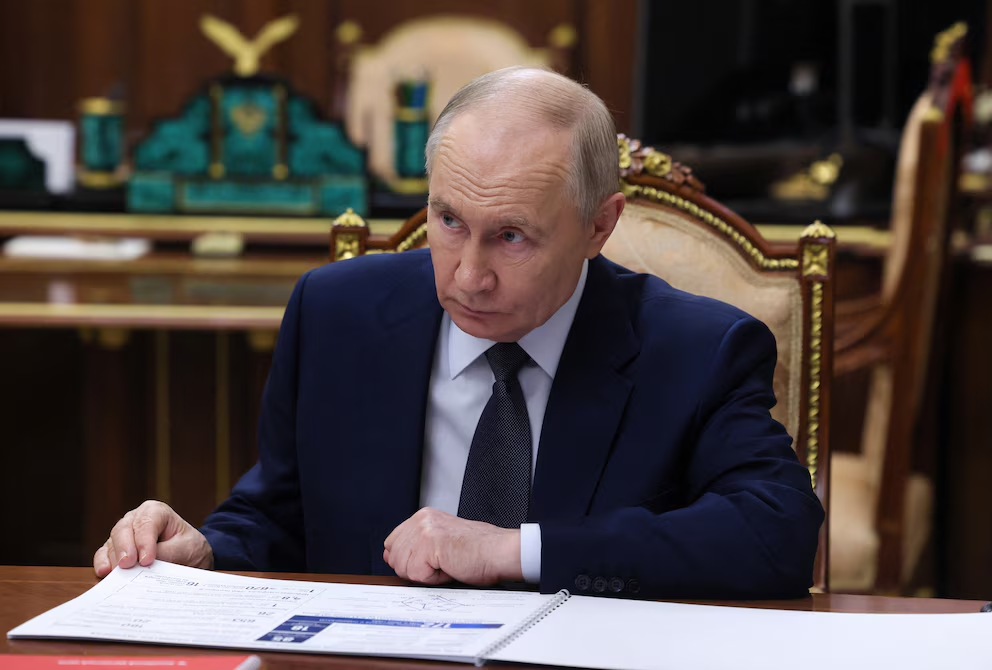
That shift in perception opened another discussion in Western capitals: whether Vladimir Putin will seek an escalation this summer or if, in reality, his viable options have already become limited. The Prime Minister of Canada, Mark Carney, said last month that Canada, Germany, the United Kingdom, and France shared the idea that “the tide has turned” and that Putin “is going to lose.”
After more than four years of costly fighting, the newspaper noted that there are few signs that Russia is close to a decisive breakthrough. That data supported one of the central hypotheses among Western strategists: the risk is not only a Russian reaction, but that the fear of such a reaction will lead Ukraine’s allies to pressure it to back down.
The West evaluated four paths of Russian escalation
According to the publication, Western officials ordered the analysis along four paths: a conventional intensification on the Ukrainian front, the use of nuclear weapons, a direct attack against NATO, and a hybrid warfare campaign against infrastructure or individuals in the West.
More Read

Local men gather to clean up a neighborhood that was severely damaged during Monday’s Russian missile and drone attacks, as part of Russia’s attack on Ukraine, in Vyshneve, on the outskirts of Kyiv, Ukraine, on July 7, 2026.
The immediate question was what Putin can do and what effect it would have. The answer the newspaper gathered was that the Russian leader still retains escalation options, but all of them involve high costs and none guarantee changing the course of the war.
On the battlefield, there is an expectation that Moscow will send more troops to the “meat grinder” of the front during the summer. Putin recently claimed that his forces took the city of Kostyantynivka, a key Kremlin objective in the eastern Donetsk region, although Volodymyr Zelensky denied and ridiculed that version.
More Read

Western officials estimated that Russia is losing soldiers faster than it can replace them: 35,000 killed or wounded per month. The possibility of a general mobilization through conscription also circulated, although that decision could trigger an adverse public reaction.

The nuclear threat has lost some of its effect
Throughout the war, Putin and his inner circle have insistently hinted at the possible use of tactical nuclear weapons. That threat, according to Western officials cited by the media, is taken less seriously today than at the beginning of the conflict.
The same officials believe that Chinese President Xi Jinping warned Putin against such a decision. They also considered that the Kremlin understood the risk of direct Western intervention in the war if Russia were to resort to nuclear weapons.
A Western official summarized that attrition with a phrase cited by the newspaper: “He devalued the currency.” The repetition of nuclear rhetoric, according to that view, reduced its power of intimidation.
Another hypothesis contemplated by some Western leaders was a Russian provocation directed against the Baltic states or Poland. Latvian security officials said that Russia was “preparing for military provocations,” potentially aimed at them.
Even so, a direct attack seemed less likely to the strategists consulted. In these four years, Putin always avoided a frontal confrontation with NATO, even when there were fears that he would strike supply lines and bases in allied territory from where weapons flowed into Ukraine.
More Read
The publication added that an escalation in the Baltic would also require moving Russian troops from the Ukrainian front. It would also expose the Kremlin to the risk of opening a second front on NATO soil and suffering a military humiliation.
The last avenue was hybrid warfare. In the last four years there have already been episodes attributed to that pattern, including a plan to place bombs inside DHL packages and an attempt to assassinate the head of Rheinmetall, one of the main German arms manufacturers.
According to the newspaper, Russia continued to ostensibly examine sensitive Western infrastructure, such as undersea cables and energy pipelines. Security officials warned that such escalation also carries risks, because the West could respond and because Russia, the United States and its allies, and China could have placed the cyber equivalent of unexploded bombs within their critical infrastructure.
Last week, missile and drone attacks killed 30 civilians in Kyiv.