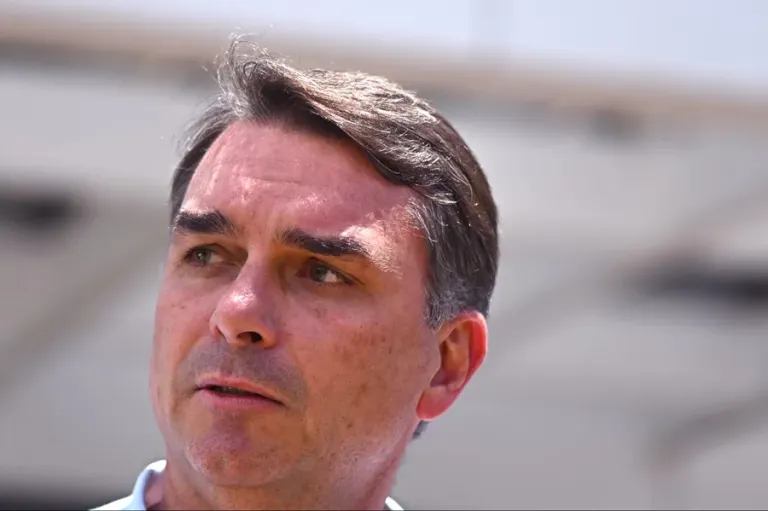
São Paulo.- The Supreme Court of Brazil prohibited presidential candidate Flávio Bolsonaro this Monday from visiting his father, the imprisoned former president Jair Bolsonaro, for 90 days for failing to comply with the precautionary measures imposed on the latter, the court reported.
Magistrate Alexandre de Moraes considered that the right-wing candidate violated the restrictions placed on the former president (2019-2022), who was sentenced to 27 years in prison for attempted coup d’état, when he read a letter written by his father on social media.
In that letter, Jair Bolsonaro reiterated his support for Flávio’s candidacy and called for unity, after the son was openly criticized by his stepmother and wife of the former president, Michelle Bolsonaro.
According to De Moraes, the reading of the letter contradicts the prohibition against Jair disseminating messages via social media, even through third parties, and “suggests” that he had “full knowledge” that the letter was going to be disseminated on digital platforms.
In that sense, the magistrate gave the far-right leader’s lawyers 48 hours to clarify whether he knew how the document was going to be disclosed, and ordered the Prosecutor’s Office to investigate whether it is a case of early electoral propaganda allegedly committed by Flávio Bolsonaro.
More Read


Visits to Jair Bolsonaro
The suspension of visits will prevent Flávio from communicating directly with his father, who named him his successor after he was convicted on September 11, 2025, during a good part of the electoral campaign.
We recommend reading: The Brazilian Supreme Court blocks the assets of the leader of the Bolsonaro party
The first round of the elections, which will be held on October 4, has as its main contenders Flávio and the current president, the progressive Luiz Inácio Lula da Silva, who is seeking a fourth non-consecutive term.
Although he began serving his sentence in a cell, Jair Bolsonaro was transferred to his home after being granted house arrest due to his numerous health problems.
More Read

Within the small group of people authorized to visit him are the doctors attending to him, his lawyers, and his closest relatives.