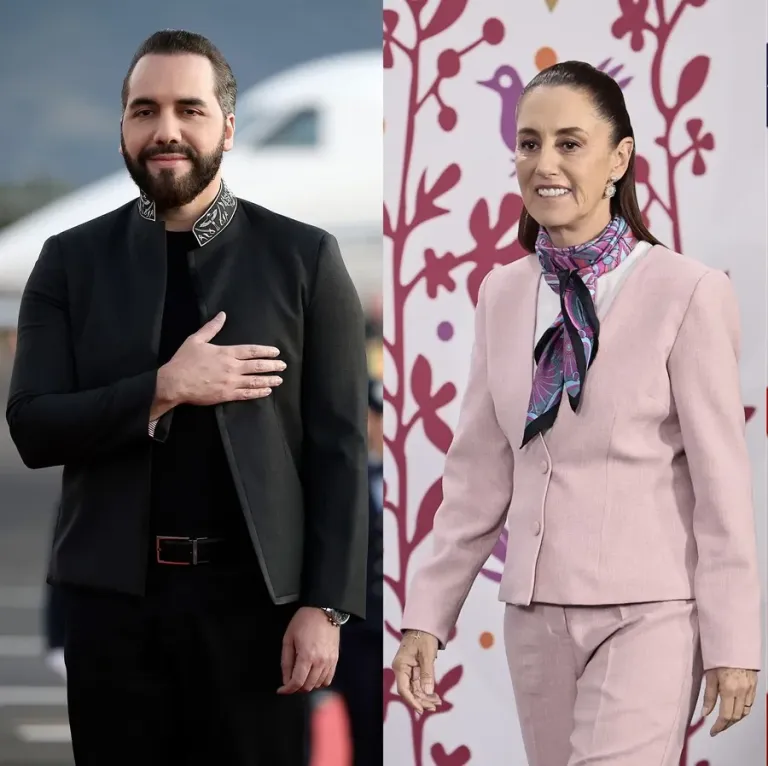
America Editorial.- The presidents of El Salvador, Nayib Bukele, and of Mexico, Claudia Sheinbaum, lead the list of Latin American leaders with the highest public approval for the second consecutive month, although both recorded a drop in their acceptance levels compared to June, according to a poll by CB Global Data, in which the acting president of Venezuela, Delcy Rodríguez, falls to last place.
Bukele leads the table with 67.4% favorability and a 28.3% negative image. Although he retains the top spot, his support fell 1.7 percentage points compared to June, when he reached 69.1%. The Salvadoran president has maintained a state of exception since March 2022 as the cornerstone of his security policy against gangs.
As for Sheinbaum, the first woman to govern Mexico, she occupies second place with a positive image of 65.1% and a 30.2% disapproval rating, 0.4 percentage points less than the 65.5% obtained in June. During the evaluated period, Mexico hosted, along with the U.S. and Canada, the 2026 FIFA World Cup.
Completing the podium is Laura Fernández, who recently assumed the Presidency of Costa Rica, with a 55.5% favorability rating against a 38.2% negative image, 0.6 percentage points below the 56.1% recorded the previous month.
The last ones in the measurement
At the end of the table is Delcy Rodríguez, acting president of Venezuela since January of this year, with barely 22.7% public support against a 70.8% negative image.
More Read

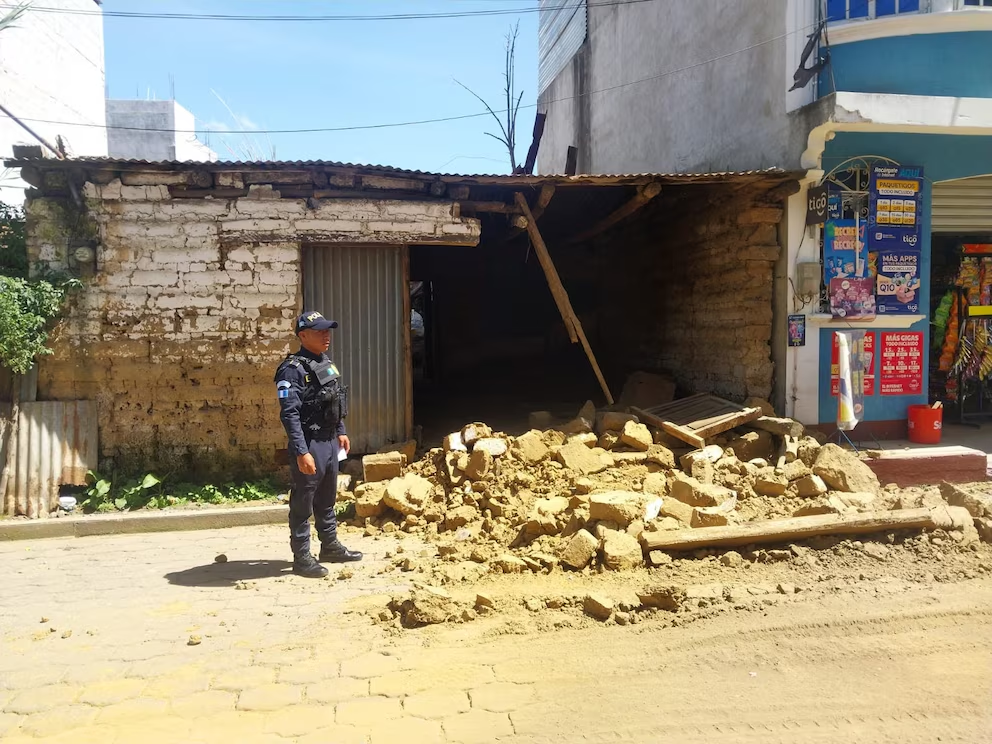
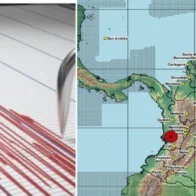
Furthermore, she was the leader who fell the most in the July measurement, losing 6.8 percentage points compared to the 29.5% in June. Venezuela suffered two devastating earthquakes on June 24 that have already exceeded 5,000 deaths and thousands of injuries, in addition to a complex humanitarian and reconstruction emergency.
In the penultimate place is the interim leader of Peru, José María Balcázar, with a 23% approval rating and a 68.5% disapproval rating. However, he was the president who improved the most in the monthly measurement, gaining 4.8 percentage points compared to the 18.2% in June. Balcázar will hand over power on July 28 to the right-wing Keiko Fujimori, winner of the presidential elections.
We recommend reading: Bukele receives recognition after the elimination of trachoma as a public health problem in El Salvador
For his part, the president of Guatemala, Bernardo Arévalo de León, completes the group of the worst-rated leaders, with 30.8% support and a 63.4% negative image, 2.3 percentage points less than in June, when he recorded 33.1% favorability.
More Read


The other presidents on the list
In fourth place is the president of Paraguay, Santiago Peña, with a 51.2% positive image and a 45.7% rejection rate, after improving from the 48.3% in June. He is followed by the president of Brazil, Luiz Inácio Lula da Silva, with a 50.6% favorability and a 47.1% negative image, above the 47.6% recorded the previous month.
Rodrigo Paz, president of Bolivia since last November, occupies sixth place with a 49.1% positive image and a 47.7% rejection rate, also above the 46.4% he obtained in June.
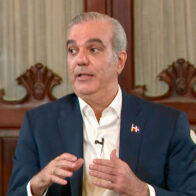
In the middle of the table appear the president of the Dominican Republic, Luis Abinader, with a 48.7% favorability rating and a 48.1% negative image; the Honduran Nasry Asfura, with 45.3% support and 50.3% rejection; and the Chilean José Antonio Kast, with 44.6% acceptance compared to a 52.8% negative image.
They are followed by the Ecuadorian Daniel Noboa, with 41% support and 55.9% rejection, and the co-president of Nicaragua, Daniel Ortega, who shares the position with his wife, Rosario Murillo, with 40.2% favorability and a 58.6% negative image.
How the survey was conducted
Colombian President Gustavo Petro ranks twelfth, with a 39.4% positive image and a 57.5% disapproval rating. Petro will conclude his term on August 7, when he will hand over power to the far-right candidate Abelardo de la Espriella, the winner of the presidential elections.
Also integrating the lower part of the poll are the Uruguayan Yamandú Orsi, with 37.4% support and a 57.5% negative image; the Argentine Javier Milei, with 36.8% favorability and 61.3% rejection; and the Panamanian José Raúl Mulino, with 34.2% acceptance against a 61.2% negative image.
More Read
The CB Global Data survey was conducted between July 3 and July 8, 2026, among citizens of 18 Latin American countries, with sample sizes ranging from 4,625 to 6,271 cases per country, a 95% confidence level, and a margin of error between ±1.2% and ±1.4%.