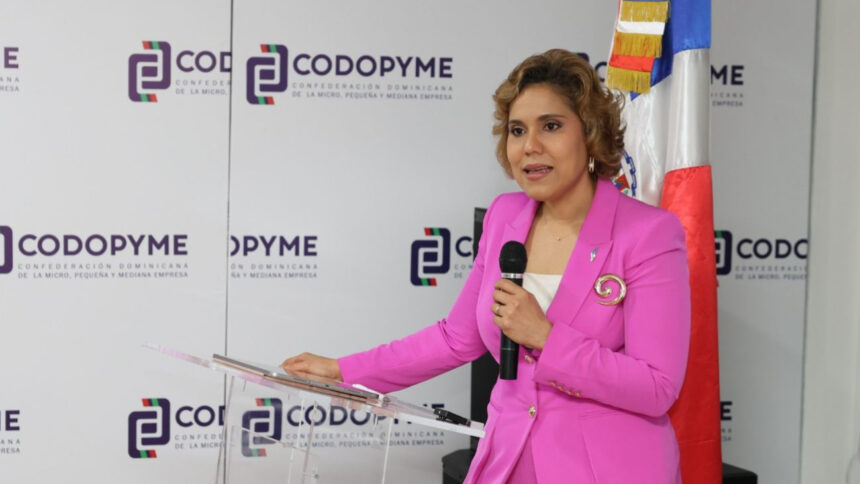
Santo Domingo.- The president of the Board of Directors of the National Commission for the Defense of Competition (ProCompetencia), María Elena Vásquez Taveras, stated that the Dominican Republic needs to modernize its competition legislation to respond to the challenges posed by the digital economy, technological platforms, and global business operations.
During a conference held at the headquarters of the Dominican Confederation of Micro, Small and Medium Enterprises (Codopyme), Vásquez Taveras presented the main axes of the proposal for the Organic Antitrust and Economic Competition Law, submitted to the Executive Branch with the objective of updating the national legal framework and providing the country with tools aligned with the new market dynamics.
He explained that, while the current legislation allowed for the creation of the competition institutional framework in the country, the changes recorded in the markets require more modern mechanisms to address phenomena such as economic concentrations, digital platforms, artificial intelligence, and transnational operations. “It has been a law that has played a fundamental role, but today the Dominican Republic faces a much more open, digital, and interconnected economy, which requires new tools to preserve competitive markets and continue promoting development,” he stated.
Recommend
As an example of this reality, he cited the recent acquisition of the Pedidos Ya platform by the company Uber, an operation agreed upon outside the Dominican Republic whose effects could impact local businesses, delivery personnel, and consumers. He pointed out that cases of this nature demonstrate the need for the country to have legal tools that allow for the timely evaluation of certain business operations with an impact on the national market.
More Read

“In practically all of Latin America, this type of operation can be analyzed beforehand by the competition authority to determine if it could substantially reduce competition or if it requires conditions that preserve the efficient functioning of the market. The Dominican Republic, however, continues to be the only country in Latin America that does not have a general prior control of economic concentrations,” pointed out Vásquez Taveras, after assuring that the legislative proposal presented on February 26 to the Executive Branch seeks to correct these details through the incorporation of a modern regime that allows for the analysis of high-impact operations before they produce effects in the markets.

The initiative also strengthens the treatment of unfair competition, introduces a Leniency Program to detect and sanction anti-competitive agreements, incorporates tools to address the challenges of the digital economy, and promotes greater coordination between institutions linked to economic regulation.
During his speech, he reiterated that free competition constitutes a public policy for economic development that boosts productivity, innovation, and efficiency, creating better conditions for business growth and the generation of opportunities for micro, small, and medium-sized enterprises.
More Read

Likewise, he highlighted the role of business associations as strategic allies in identifying regulatory barriers, promoting reforms, and strengthening the culture of competition, contributing to the construction of more open and dynamic markets.
As part of the activity, ProCompetencia and Codopyme reaffirmed their commitment to continue promoting joint initiatives aimed at strengthening the culture of competition and improving conditions for the development of Dominican MSMEs.
“The best support policy for MSMEs is not to protect them from competition; it is to guarantee them markets where they can compete on equal terms,” stated Vásquez Taveras.