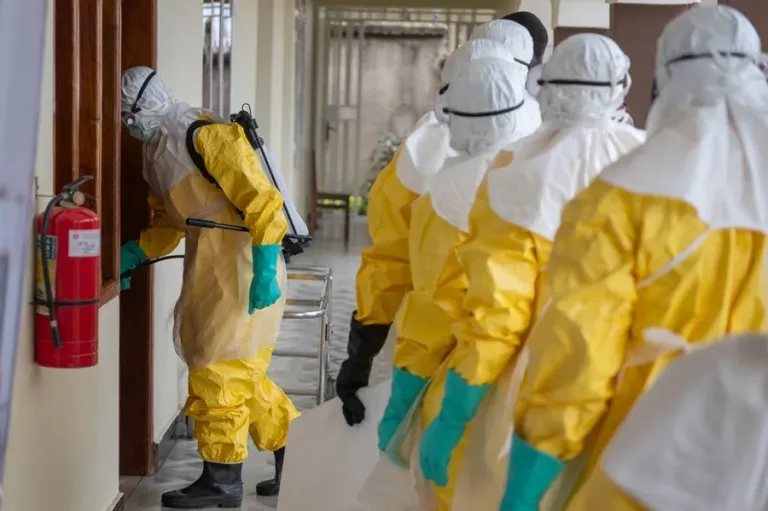
Geneva.- The World Health Organization (WHO) announced this Friday that its advisors have recommended that the Ervebo vaccine be prioritized in clinical trials in an effort to respond to the current Ebola virus outbreak in the Democratic Republic of the Congo (DRC), which has already exceeded 4,000 cases.
The recommendation is issued after the WHO technical advisory group on vaccines met on July 31 to analyze the different candidates, concluding that animal trials show that Ervebo, manufactured by the US pharmaceutical company Merck, offers “a certain level of protection.”
Until now, Ervebo is approved as a vaccine for the Zaire variant of Ebola, the best-known one and responsible for most outbreaks in recent decades, but the one currently affecting the DRC, with 1,850 deaths, corresponds to the rarer Bundibugyo variant, for which there is no authorized vaccine or specific treatment.
Tests indicated that antibodies against Bundibugyo developed with the Ervebo vaccine are weaker than those generated against Zaire ebolavirus, “but they seem to have some neutralizing effect,” according to the group of experts.
Advisory group
The advisory group was created after the WHO declared an international emergency due to the DRC outbreak on May 16, and in its previous meetings it still did not recommend trials with Ervebo, considering that it should be tested in specific research settings before its efficacy could be evaluated.
More Read


Once the levels of safety, efficacy, and availability of the potential vaccine were evaluated, the experts agreed that there are no risks in conducting trials in which contacts of those infected in the current outbreak are vaccinated, in randomized trials.
We recommend reading: WHO warns that Ebola is spreading in the DRC and its “true magnitude” is unknown
The current epidemic became on July 31 the second Ebola outbreak with the most recorded infections in history and the largest in terms of infections in the DRC, after surpassing the one that also occurred in the eastern Congo between 2018 and 2020, which caused 2,299 deaths and 3,481 cases.
This is the seventeenth epidemic to affect the DRC and it has the fastest growth of infections compared to any other outbreak since its declaration.
More Read

However, it is still far from the worst Ebola epidemic in history, which took place in West Africa between 2014 and 2016 and caused about 11,000 deaths and 28,000 infections.