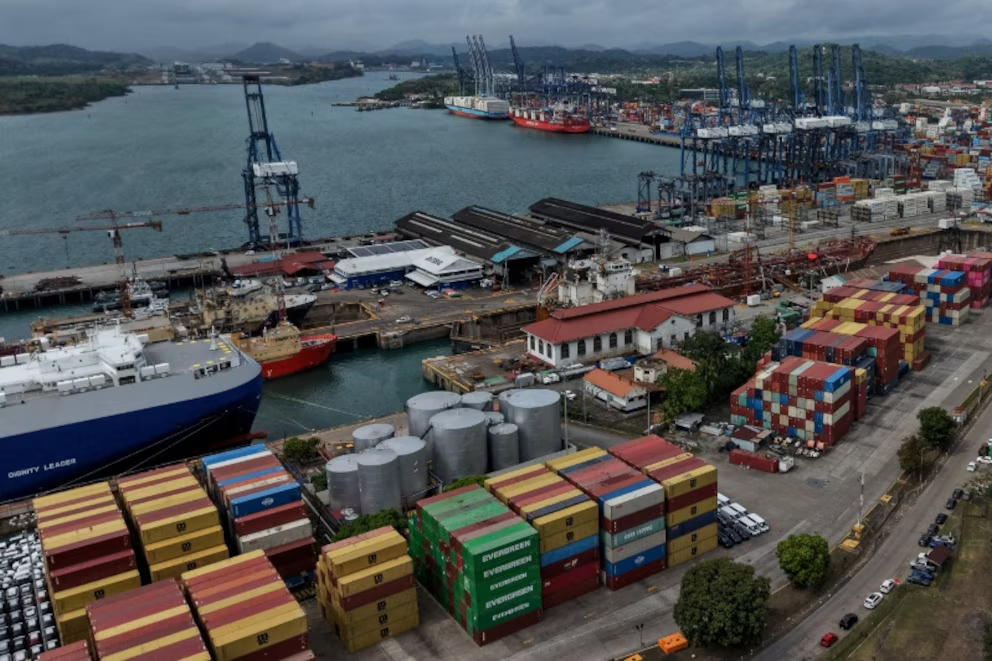
The cargo movement in Panamanian ports maintained its growth trend during the first six months of 2026. Between January and June, the National Port System handled 4,915,466 TEUs (20-foot containers), an increase of 1.8% compared to the same period in 2025.
The performance occurred amidst one of the greatest institutional changes the sector has experienced in decades: the exit of Panama Ports Company (PPC) from the Balboa and Cristóbal ports following the Supreme Court of Justice ruling that declared unconstitutional the contract, its addenda, and the extension that kept the subsidiary of the Hong Kong conglomerate CK Hutchison in charge of both terminals.
Although growth was moderate compared to the previous year, the figures from the Panama Maritime Authority (AMP) show that the system once again reached a recent high.
In the first semester of 2024, 4,750,876 TEUs were moved; in 2025 the figure increased to 4,829,562, and this year it reached 4,915,466 TEUs, consolidating a positive trend driven by the recovery of maritime trade and the strengthening of transshipment operations, the main activity of Panamanian ports.
Balboa and Cristóbal are operating under temporary administrations while the Government defines the definitive model for both concessions.
More Read

We recommend reading: Mulino highlights alliance with Mexico and asks for support for the neutrality of the Canal
The monthly evolution was irregular, but it ended with a quite solid close. June became the most active month of the semester, with 876,499 TEUs, even surpassing January, which had started the year with 865,677 TEUs.
The lowest point was recorded in February, when the movement fell to 697,585 TEUs, before regaining sustained momentum between March and June. That recovery made it possible to offset the decline at the beginning of the year and close the semester with figures higher than those of 2025.
More Read

However, the system’s growth was not uniform across the terminals. SSA Marine MIT consolidated its position once again as the port with the highest movement in the country by handling 1,610,841 TEUs, an increase of 23.1% compared to the previous year.
Also highlighted was Colón Container Terminal, which handled 981,246 TEUs, an increase of 19.8%, while PSA Panama International Terminal reached 742,238 TEUs, with a growth of 5.4%. Between the three terminals, they more than compensated for the decline recorded in Balboa and Cristóbal.
Transshipment continues to be the main driver of the Panamanian port system and concentrates the majority of container movement.
The behavior was very different in the two ports managed until March by Panama Ports Company. Balboa, at the Pacific entrance of the Panama Canal, recorded 1,143,984 TEUs, a decrease of 11.9%, while Cristobal, on the Atlantic, moved 409,685 TEUs, which represented a drop of 34.9%, the largest among all terminals in the national port system.

That performance coincided with the transition process initiated after the decision of the Supreme Court of Justice, which declared the 1997 concession contract, the subsequent addenda and the extension approved in 2021 for Panama Ports Company to be unconstitutional.
The ruling, published in the Official Gazette on February 23 of this year, allowed the State to regain control of the Balboa and Cristóbal terminals and opened a new chapter for two of the most strategic ports in the country.
More Read

As part of that process, the Government appointed temporary administrators for a period of 18 months. The operation of the port of Balboa was placed in the hands of APM Terminals Panama S.A., through a 26.1 million dollar contract for the operation, maintenance, and management of the Pacific terminal.
Meanwhile, the port of Cristóbal came to be managed by TIL Panamá S.A., a subsidiary of Mediterranean Shipping Company (MSC), under a $15.8 million agreement to maintain operations on the Atlantic coast while the definitive concession model is defined.
Vehicle movement also increased during the first semester, reflecting the dynamism of the Panamanian logistics platform.
The reorganization also transcended the purely logistical sphere. The departure of PPC sparked a new focus of tension between Panama and China, after Chinese government authorities questioned the decisions adopted by the Panamanian State regarding a company linked to the CK Hutchison group.
Panama, for its part, has maintained that the measures respond exclusively to compliance with the Supreme Court ruling and respect for the constitutional order.
AMP figures also show that system growth continued to be supported by transshipment, which accounted for 4.35 million TEUs, while local cargo reached 537,315 TEUs, an increase of 9.7% compared to the first half of 2025, reflecting a greater movement of goods destined for the Panamanian market and national exports.
Another indicator that confirmed the sector’s dynamism was the movement of vehicles. Between January and June, 90,301 automobiles passed through Panamanian ports, a growth of nearly 24% compared to the same period of the previous year.
You can also read:
The greatest boost came once again from SSA Marine MIT, while Balboa increased vehicle shipments and PSA maintained a positive trend, partially offsetting the lower activity recorded in Cristóbal.
Although the port system managed to close the semester with a new recent record in container movement, the second semester will be marked by a quite complex challenge: maintaining growth while the temporary administration of Balboa and Cristobal advances and the Government defines the future of two terminals considered key pieces for Panama’s logistics competitiveness and for an interoceanic route through which nearly 3% of global maritime trade passes.