The illicit trade of tobacco, alcohol, agrochemicals, and electronics has taken hold in Central America due to a series of structural and regulatory failures that persist in the region, according to a recent report by the Transnational Alliance to Combat Illicit Trade (TRACIT).
The presentation of the “Assessment of Central America’s Performance in the Illicit Trade Index” took place in Panama City, with the participation of business representatives and experts, as reported by EFE. The study examines the situation of 158 economies in six different areas, including the tax environment, regulation, government controls, corruption, and anti-money laundering systems.
The report highlights that the lack of customs control in free trade zones and the weakness of intermediaries in the supply chain facilitate the illegal flow of a wide range of products. Furthermore, it points to the existence of a robust informal economy, the misuse of free trade zones, and an unequal state monitoring capacity that favor the expansion of illicit trade in the region.
Most exposed countries and factors fueling illicit trade
According to the 2025 index, Costa Rica and Panama lead the Central American list with 51.2 and 49.6 points respectively. They are followed by El Salvador, Belize, Guatemala, Honduras, and Nicaragua, the latter with scores that reflect greater vulnerability.
Within Latin America, Uruguay stands out as the best-positioned country. The global average of 49.9 points out of 100 indicates that most governments in the world are not prepared to prevent or mitigate illicit trade.
More Read
We recommend reading:
The report on Central America evaluated 158 economies and analyzed the tax environment, regulation, government controls, corruption, and money laundering. (Illustrative Image Infobae)
The Tracit report maintains that, although some Central American countries show progress, the region as a whole continues to face significant obstacles in controlling the illegal circulation of products, according to what was reported by EFE.
More Read

The document mentions that the Colón Free Trade Zone in Panama and the Corozal Free Trade Zone in Belize are critical hotspots, as they handle high volumes of re-exports with low transparency regarding beneficial owners and minimal physical inspection of high-risk goods, such as cigarettes and distilled spirits.

The research warns that these factors, together with deep-rooted corruption and informality, allow the illicit trade of goods such as tobacco, alcoholic beverages, electronics, medicines, and counterfeit or adulterated agricultural products to remain active and connected at a regional level.
Affected products, risks and government responses
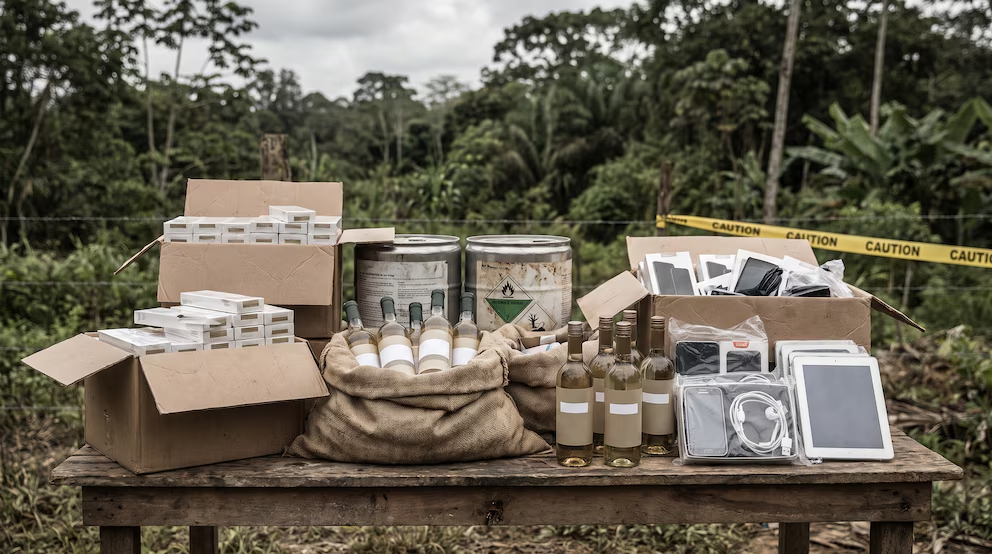
Among the products most affected by illegal trade are cigarettes, alcoholic beverages, and electronics, mainly of Asian origin.
Added to this are counterfeit medicines—antibiotics, painkillers, flu treatments, and dermatological products—and the circulation of adulterated or stolen pesticides, fertilizers, and seeds. This illicit flow poses a risk to health and food security.
The lack of customs control in free trade zones and the weakness of the supply chain facilitate the illegal flow of products in Central America. (Illustrative Image Infobae)
Illegal trade networks exploit gaps in supply chain monitoring and the lack of effective inspections to move merchandise on a large scale throughout the region.
More Read

The report notes that Central American governments increasingly recognize illicit trade as a priority issue and have begun to establish control measures and safeguards. Tracit proposes that free trade zones be formally declared under customs jurisdiction, with full rights to inspect and control warehouses and points of entry or exit.
According to the document, “Central America’s growing efforts to strengthen transparency and supply chain integrity, along with ongoing progress to address institutional capacity constraints and align regulatory frameworks with international treaties and standards, provide a solid foundation for increasing resilience against illicit trade throughout the region”.
As the region advances in coordination and regulatory updates, the Tracit report underscores the need to deepen these efforts to combat illicit trade and protect both the economy and public health.