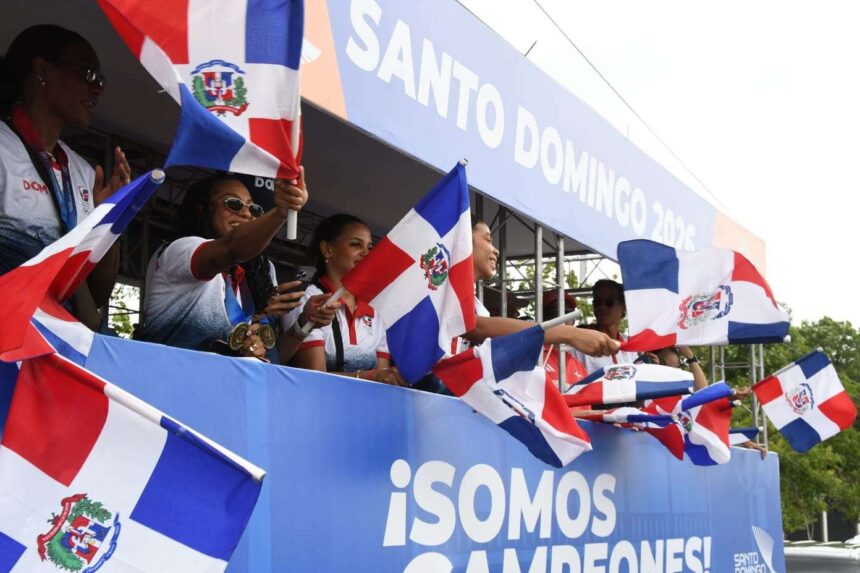
Santo Domingo.- With their medals hanging around their necks and in the rain, Dominican athletes traveled through different parts of Greater Santo Domingo this Sunday to share with the public the results obtained by the country in the XXV Central American and Caribbean Games Santo Domingo 2026.
The Dominican Republic delegation finished its participation with 150 medals, distributed into 46 gold, 37 silver, and 67 bronze, a figure that represents the highest number of medals achieved by the country in an edition of the Central American and Caribbean Games.
The record surpassed the 131 medals obtained in San Salvador 2002, when the Dominican delegation achieved 33 gold, 36 silver, and 62 bronze.
The celebration began with the gathering of the athletes at the Juan Pablo Duarte Olympic Center. From there, the caravan organized by the Ministry of Sports and Recreation, led by Kelvin Cruz, set off so that the competitors could meet with the public after several weeks of competition.
Dressed in the colors of the flag and carrying the medals won in their respective disciplines, the members of the national team advanced through different sectors of the National District and Santo Domingo.
More Read
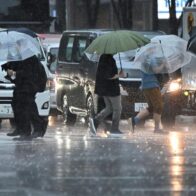
During the journey, people positioned themselves at different points along the route to greet the competitors, take photographs, and wave flags. Rain accompanied part of the route, without causing the activity to be suspended.
The caravan concluded at Eugenio María de Hostos Park, on the Malecón of Santo Domingo, where the authorities organized an artistic activity as part of the closing of the festivities.
Athletes share what was behind the medals
The celebration also allowed us to learn the stories of several of the competitors who contributed medals to the Dominican medal count.

Juan Miguel Arias, a member of the men’s softball team, was one of them. Known as “The Prototype,” the player was part of the squad that secured the gold after defeating Venezuela 5-1.
Arias explained that he began his sports career playing baseball, but found in softball the opportunity to represent the Dominican Republic.
The player recalled the training days and the difficulties he went through before reaching the podium. When speaking about what it meant to win the championship on Dominican soil, he summarized the process with one phrase: “It was worth every effort”.
Arias dedicated the medal to God, his family, and the fans who supported the team throughout the tournament.
He also pointed out that the support received from the stands influenced the way the team approached the matches. As he explained, the players took on each game with the obligation to compete until the end.
Esmery Martínez and the 3×3 basketball gold
Another of the protagonists was Esmery Martínez, a member of the Dominican team that won the gold medal in women’s 3×3 basketball.
More Read
Martínez recalled that during the game she insisted to her teammates on maintaining concentration until the clock reached zero. The player also contributed a basket during the final stretch of the match.
For the basketball player, competing in front of Dominican fans had a special meaning due to the presence of people who came to support the national team.
The athlete dedicated the medal to God, her family, and the young people who are beginning to develop in the sport.
With the gold already secured and before participating in the celebration, Martínez summarized the moment with an expression that he carried from the field to the motorcade: “He who wins is the one who enjoys.”

A family with 12 medals in water skiing
Among the stories left by Santo Domingo 2026 is that of the Pigosi brothers, natives of Boca Chica, who collected 12 medals in the water skiing competitions.
The three brothers stood on the podium during the Games and won gold, silver, and bronze medals. Andrea Pigosi, for example, finished her participation with one gold medal and two silver ones.
Beyond the individual results, the brothers valued the opportunity to compete together and do so in front of the Dominican public.
The athletes explained that one of their goals is to help make water skiing known to more people in the Dominican Republic and to encourage other young people to take up the sport.
They also acknowledged the support of their parents during their development as athletes and the accompaniment received during the competitions.
Their participation left an unusual image within a sports delegation: three members of the same family contributing medals to the Dominican Republic’s results in a single edition of the Games.
Athletics and karate also contributed to the medal count
The Dominican harvest had participation from different disciplines.
In athletics, Liranyi Alonso won four gold medals between the 100 and 200-meter events and the relay competitions.
The Dominican Republic also climbed to the top of the podium in the 4×400 meter mixed relay with Marileidy Paulino, Anabel Medina, Erick Sánchez, and Christopher Melenciano.
In karate, María Dimitrova won gold again in kata and reached her sixth consecutive gold medal at the Central American and Caribbean Games.
Other athletes took advantage of the meeting with the public to talk about the years of preparation that preceded their results and to motivate children and young people to get involved in the different sports disciplines.
A record for the Dominican Republic
The 150 medals obtained in Santo Domingo 2026 placed this edition above any previous participation of the Dominican Republic in the Central American and Caribbean Games.
The result takes on another dimension for having been achieved as the host country, with Dominican athletes competing before family, supporters, and the local public.
The final tally of 46 golds, 37 silvers, and 67 bronzes also left behind stories that go beyond the medal table: athletes who switched disciplines to be able to represent the country, siblings who reached the podium together, and national teams that played their finals in front of stands filled with Dominican fans.
After the conclusion of the competitions, the caravan moved those stories from the sports arenas to the streets.
For the athletes, another stage begins now. Part of the delegation will continue their preparation within the international sports cycle, while federations and authorities will have the challenge of providing continuity to the training and development processes for new competitors.
This Sunday, however, the marks, times, and positions were pushed into the background for a few hours. The protagonists were the men and women who traveled through Santo Domingo with their medals around their necks and the people who came out to welcome them.
The rain fell during part of the journey. The caravan continued. And the 150 medals that were on podiums and sports stages during the Games ended up traveling through the city streets alongside those who won them.